In January 2024, OpenAI CEO Sam Altman sparked an industry-wide debate when he revealed a running bet among tech founders: when would we see the world’s first “one-person billion-dollar company”—a software titan operated by one or two individuals leveraging extreme artificial intelligence force multipliers.
What most commentators in San Francisco overlooked was that two months earlier, five thousand miles away in Murcia, Spain, two seasoned engineers and entrepreneurs had just shipped Europe’s purest real-world prototype of that post-AGI thesis.
With zero venture capital, zero paid advertising, zero additional employees, and roughly half of their production codebase co-written alongside AI coding assistants, Javi López and Emilio Nicolás launched Magnific AI in late November 2023.
Within five months, they crossed 725,000 registered users, built a multi-million-dollar recurring revenue engine as a two-person team, drew organic public praise on X from digital art icon Beeple and Elon Musk, and completed an exit to Málaga-based giant Freepik structured around €20 million upfront cash plus multi-year earn-outs. Even more remarkably, on April 28, 2026, the acquiring giant officially rebranded its entire global corporate identity to Magnific after surpassing $230 million in Annual Recurring Revenue (ARR).
Continuing our technical series dissecting Spain’s most impactful technology companies and deep-tech scale-ups—alongside RavenPack, HappyRobot, Submer, Multiverse Computing, Wallapop, Flywire, Clarity AI, Devo, Nextail, and Carto—this case study unpacks Magnific AI’s origins, its viral X playbook, its tiled diffusion architecture, and what a two-founder exit tells engineers about the post-AGI economy.
The Origins: From Erasmusu and a Sabbatical to an AI Lab in Murcia
Unlike the Silicon Valley stereotype of first-time college dropouts, Javi López and Emilio Nicolás brought thirteen years of battle-tested operational discipline to the table.
Back in 2009, the pair had co-founded Erasmusu, scaling it into Europe’s largest online community and accommodation marketplace for international exchange students before selling the business to Spotahome. Following a well-earned sabbatical after more than a decade running marketplaces, both spotted an unmistakable tectonic shift in April 2022: early image diffusion models were beginning to turn raw text prompts into coherent visual compositions.
Rather than rushing to incorporate a wrapper startup overnight, Javi López spent eighteen straight months experimenting in public:
- Building distribution before writing product code: Through his personal X account (
@javilopen) and his Substack newsletter (Latent Space), he published hundreds of prompt engineering experiments, side-by-side model tests, and open visual tutorials for creators. - Isolating the exact visual bottleneck: While tools like early Midjourney and Stable Diffusion amazed casual users, studio illustrators, architects, and concept artists kept slamming into the same wall: outputs rendered at low resolution, and standard mathematical upscalers left skin textures, fabrics, and architectural details looking blurry and plastic.
- Shipping at AI-assisted velocity: Operating on a lean budget under $5,000 and hiring zero outside contractors, the duo spent roughly three intense months building the first release. As López later shared, nearly 50% of Magnific’s codebase was authored using Cursor and Claude—foreshadowing in late 2023 the structured AI engineering workflows we now formalize under Spec-Driven Development.
Viral X Chronicle: Launch Threads, “Computer, Enhance!” & Beeple
If Magnific’s rendering engine turned heads technically, its go-to-market trajectory remains one of the cleanest case studies in organic, product-led distribution on X (formerly Twitter).
On November 27–28, 2023, following a tight two-week waitlist and launching straight into a paid-only tier with zero free trials to prevent GPU unit-economics collapse, the founders opened access by posting dramatic “before and after” interactive sliders.
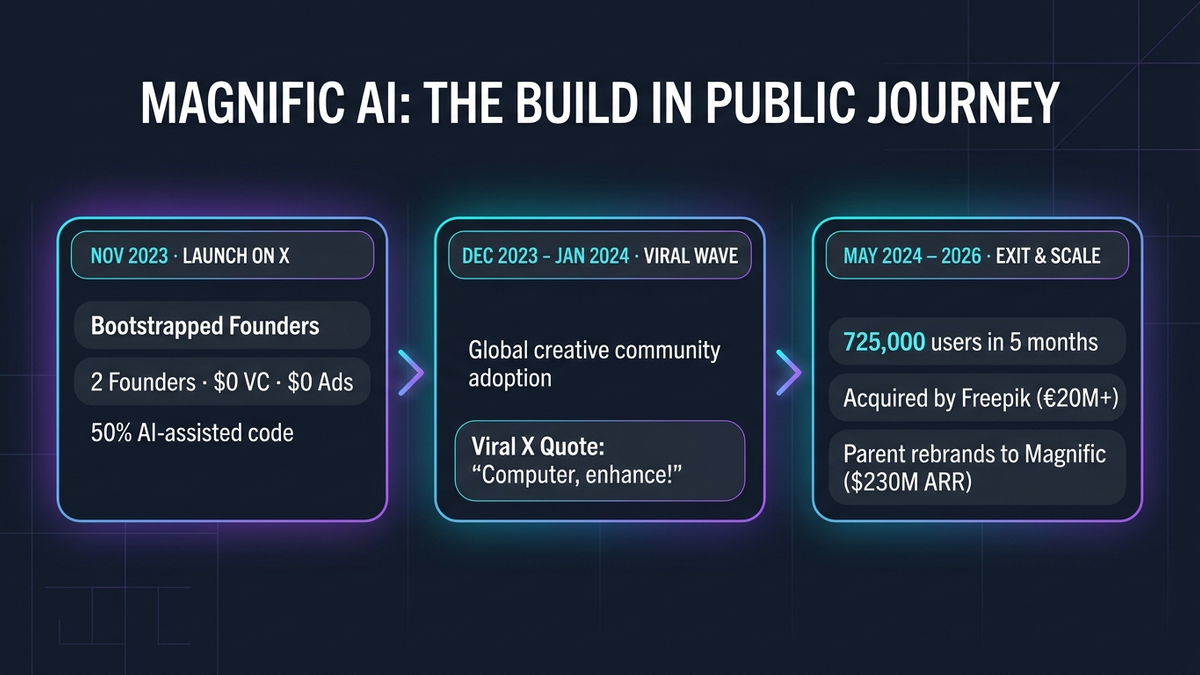
Three X Moments That Catapulted the Startup Worldwide
-
1. The launch wave and organic creator proof (
@javilopen, November 2023):
Because Javi López had spent a year and a half earning technical credibility in AI art circles on X, launch day needed zero ad spend. When creators uploaded low-res 1990s video game sprites, hand-drawn pencil sketches, or blurry AI generations and watched pores, stitching, foliage, and metallic reflections materialize in crisp high definition, the entire visual timeline turned into a self-propelling showcase. -
2. Beeple’s daily workflow endorsement (
December 19, 2023):
Barely three weeks post-launch, pioneering digital artist Mike Winkelmann (Beeple) messaged the founders privately sharing that he used Magnific every day in his creative practice. Javi captured the milestone publicly on X:“Knowing that @beeple, one of the artists I admire the most, is using and enjoying Magnific in his artworks is a dream come true ❤️” —
@javilopenon X (December 19, 2023) -
3. Elon Musk’s viral reply (
January 8, 2024):
The true inflection point struck when AI designer Linus Ekenstam shared a viral thread on X demonstrating a dramatic8xupscale processed with Magnific AI. Amid millions of impressions, Elon Musk (@elonmusk) jumped directly into the thread quoting the iconic sci-fi cinema meme:“Computer, enhance!” —
@elonmuskon X (January 8, 2024)López later recounted in interviews that he had spent years trying unsuccessfully to get Musk’s attention; letting a mind-bending visual product speak for itself organically put the two-person Spanish startup in front of tens of millions of viewers overnight at a customer acquisition cost of literally zero.
The Core Engineering: Turning Hallucination into a Product Slider
Why did Magnific AI leave open-source deterministic upscalers (such as classic ESRGAN weights or bicubic interpolation) in the dust, and why couldn’t users replicate it with a simple generalist prompt?
While the Large Language Model (LLM) industry was pouring billions into eliminating hallucinations, Javi López and Emilio Nicolás recognized a contrarian insight: in visual generation and creative direction, bounded hallucination is not a bug—it is the core product.
When you enlarge a blurry 256×256 image up to 4K using strictly deterministic pixel math, the algorithm can only smooth edges or average surrounding colors; it cannot infer how brushed aluminum catches light or how woven linen behaves under soft shadows. Magnific solved this through a text-conditioned Tiled Latent Diffusion pipeline governed by precision constraint sliders:
Low-Res Image +
Semantic Prompt"] --> T["2. Tiled Latent Split
Overlapping latent tiles
with global context guidance"] C["Creativity Slider
Controls allowable generative
detail hallucination"] --> D R["Resemblance Slider
Structural anchor preserving
identity & geometry"] --> D H["HDR & Fractality
Local micro-contrast,
lighting depth & texture"] --> D T --> D["3. Diffusion Inference
Prompt-guided latent
denoising on GPU clusters"] D --> M["4. Seamless Blending
Color matching & artifact-free
4K/8K reconstruction"] style I fill:#0F172A,stroke:#38BDF8,stroke-width:2px,color:#FFFFFF style T fill:#EFF6FF,stroke:#3B82F6,stroke-width:1.5px,color:#1E3A8A style C fill:#FAF5FF,stroke:#A855F7,stroke-width:1.5px,color:#581C87 style R fill:#EFF6FF,stroke:#2563EB,stroke-width:1.5px,color:#1E3A8A style H fill:#FEF3C7,stroke:#F59E0B,stroke-width:1.5px,color:#92400E style D fill:#0F172A,stroke:#A855F7,stroke-width:2px,color:#FFFFFF style M fill:#D1FAE5,stroke:#10B981,stroke-width:2px,color:#065F46
🔍 Haz clic en el diagrama para ampliarlo a pantalla completa
That architecture gave creative professionals three intuitive, deterministic dials over stochastic diffusion models:
Creativity(Controlled Hallucination): Governs how boldly the diffusion denoiser is allowed to invent brand-new micro-textures, lighting highlights, and organic imperfections absent from the source file.Resemblance(Structural Anchoring): Applies an inverse structural tether preventing the model from drifting away from a portrait’s identity, typography geometry, or architectural perspective.HDR: Modulates perceived dynamic range, crispness, and tactile depth across fine surfaces.
By pairing tiled latent synthesis with semantic prompt guidance (“vintage Swiss chronograph under rain-slicked neon light, 85mm macro”), creators stopped passively enlarging blurry pixels and gained surgical control over generative imagination.
From a Five-Month Exit to Freepik’s 2026 Corporate Rebrand
Rejecting inflated venture-backed burn rates, Magnific AI traced one of the most capital-efficient value-creation arcs in European technology:
- November 2023 – May 2024 (Bootstrapped Hypergrowth): Within five months of launch, the two-person operation surpassed 725,000 registered users while remaining cash-flow positive from week one—using upfront subscriptions to fund real-time GPU inference overhead without external equity dilution.
- May 2024 (Strategic Acquisition by Freepik): Just five months after day one, Málaga-headquartered giant Freepik—backed by private equity firm EQT and led by CEO Joaquín Cuenca—acquired 100% of Magnific AI. Subsequent financial reporting from outlets like Ecotechers disclosed a structure built around €20 million in fixed upfront cash plus multi-year performance earn-outs tied to milestones and founder continuity.
- Product Suite Expansion (
Relight,Structure,Mystic,Precision): Far from remaining a single-feature upscaler, López and Nicolás expanded the engine into physical AI scene relighting (Relight), style consistency transfers, and flagship generation models such as Mystic. - April 28, 2026 (The Acquired Brand Becomes the Mothership): In one of the boldest strategic pivots in European software, Freepik officially rebranded the entire global company under the Magnific name as the group topped $230 million in ARR across more than one million paying subscribers. A two-person Murcian startup acquired just two years earlier wound up defining the identity, visual engine, and “no-collar economy” roadmap of the entire enterprise.
Post-AGI Unit Economics: What This Means for Builders
Magnific AI’s trajectory ties directly into Datalaria’s ongoing engineering thesis on agentic enterprise operations under SDD and closed-loop cybernetic control systems:
When two founders ship roughly 50% of their production stack alongside AI coding assistants, build distribution organically before hiring a single salesperson, and generate tens of millions in enterprise value without raising venture capital, headcount is no longer the primary constraint—specification rigor, technical architecture, and distribution leverage are.
That exact principle—amplifying small engineering teams by orchestrating specialized AI agents behind strict deterministic quality gates—powers Datalaria Helix. If you lead engineering or product teams and want to deploy a structured 12-agent SDD engineering squad inside your own repositories, join our priority waitlist below:
Datalaria Helix: Your 12-Agent AI Engineering Squad Powered by SDD
Deploy in your own project the exact 12-specialized-agent operating system (Orchestrator with XS–XL triage, Product Analyst, Systems Architect, UX/UI Designer, Frontend, Backend, APIs & MCP, Media & i18n, Monetization, Security, QA Verifier with veto power, and Release/DevOps) we use to audit and ship Datalaria's production apps.
Updated Spanish Tech Startup Benchmark
Adding Magnific AI completes Datalaria’s panoramic benchmark of Spain’s premier technology success stories, spanning foundational enterprise SaaS to frontier AGI-era products:
| Startup / Company | Global HQ | Founded | Business Model | Core Technology Focus | Key Milestone / Scale |
|---|---|---|---|---|---|
| Magnific AI | Murcia / Málaga | 2023 | B2C/B2B GenAI SaaS | Tiled Latent Diffusion, Creative Upscaling & Relight | 725K users in 5 months (2 founders); €20M+ Freepik exit & global corporate rebrand ($230M+ ARR) |
| RavenPack | Marbella / NY | 2003 | B2B Data SaaS | Financial NLP, Event Taxonomy, Knowledge Graphs, Bigdata.com | Wall Street’s silent oracle; 200+ staff; FT Group alliance |
| Submer | Barcelona | 2015 | B2B Hardware / AIaaS | Single-phase immersion cooling for high-density AGI clusters | $55.5M Series C; 56 MW supercomputing campus |
| HappyRobot | San Francisco / Madrid | 2021 | B2B Voice AI Agents | Autonomous voice agents (<500ms) for freight & supply chains | $1.2B Unicorn; YC S23 alum; DHL, Schneider & Uber Freight |
| Wallapop | Barcelona | 2013 | C2C Marketplace | Computer Vision, semantic search, and geospatial matching | 19M+ users; majority acquisition by NAVER (>€800M) |
| Multiverse Computing | San Sebastian | 2019 | B2B Deep Tech | Tensor networks and quantum-inspired compression for LLMs | CompactifAI LLM compression; European quantum software leader |
| Graphext | Madrid | 2017 | Product-Led SaaS | Visual graph clustering, dimensionality reduction, embeddings | No-code exploratory data science platform |
| Flywire | Valencia / Boston | 2011 | Fintech B2B Payments | Complex cross-border payment flows and receivables automation | NASDAQ IPO ($FLYW); global enterprise payments network |
| Nextail | Madrid | 2014 | B2B Enterprise AI | Stochastic inventory optimization for fast fashion supply chains | Prescriptive merchandising deployed across 30+ countries |
| Clarity AI | Madrid / NY | 2017 | B2B SaaS ESG Analytics | Probabilistic machine learning and sustainability data cleaning | Coverage across 70,000+ firms; BlackRock partnership |
| Devo | Madrid / Boston | 2011 | B2B Cloud Analytics | Petabyte-scale real-time log ingestion and streaming analytics | $1.5B+ Unicorn; mission-critical SOC backbone for Fortune 500 |
| Carto | Madrid / NY | 2012 | B2B Spatial Analytics | Cloud-native Spatial SQL and GIS analytics over Lakehouses | Global geospatial platform integrated with Google & Snowflake |
5 Engineering & Product Lessons from Magnific AI
- Build your distribution 18 months before your product (Audience-First): Magnific’s unfair moat did not begin on launch day; it grew out of eighteen months of open experiments, tutorials, and trust built by Javi López on X and Substack. When they shipped, their exact ideal buyers were already watching.
- Invert the industry’s biggest flaw into your signature feature: While model labs fought to suppress text hallucinations, López and Nicolás turned geometrically bounded visual hallucination (
Resemblancevs.Creativity) into an unmatched creative superpower. - Charge from day one when marginal GPU inference costs money: Opening a free tier on heavy diffusion workloads would have bankrupted two bootstrapped founders in 48 hours. Day-one paid subscriptions self-funded compute infrastructure and filtered for high-intent professionals.
- Prior founder reps multiply AI-coding speed: Writing ~50% of the code via Claude and Cursor compressed development into three months, yet pricing discipline, viral launch orchestration, server scaling, and M&A negotiation came straight from thirteen years of operating Erasmusu.
- Never bet against tiny, high-leverage teams in the post-AGI era: Two domain-obsessed builders leveraging modern AI tooling defined an entire software category before an enterprise committee would have finished scoping the budget.
An Open Question for the Reader
Magnific AI leaves every software architect, founder, and executive leader in 2026 staring at an uncomfortable strategic question:
If two founders working out of Murcia can build a product in three months—on a sub-$5,000 budget with half its codebase co-authored by AI—attract organic praise from Elon Musk, exit for €20M+ in five months, and reshape a $230M ARR corporation:
Which traditional corporate moats—headcount, proprietary boilerplate code, or a Silicon Valley zip code—truly survive intact as we enter the era of AGI-leveraged micro-teams?
References and Further Reading:
- Upscale Conf San Francisco (YouTube): Interview with Javi Lopez from Magnific AI
- Itnig Podcast #328 (YouTube, Spanish): ¡CREAR y VENDER una EMPRESA de IA en 5 MESES! | Magnific AI
- Javi López on X:
@javilopen - El País: Inside the first AI-era startups: “A few years ago, two people alone couldn’t have built this”
- Tech.eu: Freepik acquires Spanish AI image upscaler Magnific
- Startup Founder Stories: How Javi López and Emilio Nicolás scaled Magnific AI from $0 to millions with 2 founders
- Fortune: Freepik rebrands to Magnific at $230M ARR in its generative AI pivot
- Datalaria: Freepik — How a Málaga Tech Giant Tamed AI to Conquer Creativity
- Datalaria: HappyRobot — How Autonomous Voice Agents Conquered Global Logistics
- Datalaria: RavenPack — From Marbella News Analytics to Wall Street’s Brain
- Datalaria: Submer — Liquid Immersion Cooling for AGI Supercomputers
- Datalaria: Spec-Driven Development vs. Vibe Coding
💼 Evaluate AI Investments & GPU Unit Economics with Financial Rigor
Want to stress-test GPU inference margins, customer payback periods, and M&A valuation scenarios before your Investment Committee? Apply our quantitative framework in Financial Business Case (NPV, IRR & Tornado) and access the Executive Pack in the Resources Catalog.