You snap a quick photo of a vintage bicycle or a used smartphone on Wallapop. In less than 200 milliseconds, without the user perceiving the slightest delay, a real-time cascade of distributed microservices and Machine Learning models springs to life:
- A computer vision model processes raw image pixels, identifies brand, model, and cosmetic condition, and assigns catalog taxonomy automatically.
- A dynamic pricing algorithm evaluates closed transaction history, competing inventory within a 5-kilometer radius, and buyer demand elasticity to suggest an optimal selling price range.
- A knowledge graph engine analyzes device fingerprints, account behavioral trajectories, and network metadata to ensure the listing is not an attempt at fraud or stolen property.
- An environmental accounting model computes the exact kilograms of carbon dioxide (CO₂), liters of water, and raw materials saved if that item finds a second life instead of being manufactured brand new.
To the average user, Wallapop is simply an intuitive mobile app for buying and selling second-hand goods in their neighborhood. But to a data engineer, Wallapop is one of the most complex, high-scale distributed systems of Machine Learning, computer vision, and graph analytics in Europe.
Continuing our deep-dive series on landmark technology companies founded in Spain — following our architectural explorations of petabyte-scale log ingestion at Devo, geospatial intelligence at Carto, sustainable AI at Clarity AI, retail optimization at Nextail, and global payment gateways at Flywire —, this article dissects the invisible engineering powering Wallapop, its architectural evolution, and the major milestone of its acquisition by South Korean internet titan NAVER.
The Origin: From a Barcelona Garage to Dominating Southern Europe
In early 2013, the Spanish online classifieds market was dominated by legacy desktop portals born in the early 2000s: Segundamano.es, Milanuncios, and eBay. These platforms were slow, desktop-oriented web interfaces requiring endless form fields and anonymous email threads with distant sellers.
Wallapop’s founders — Agustín Gómez, Gerard Olivé, and Miguel Vicente (incubated at Antai Venture Builder in Barcelona) — grasped a structural paradigm shift that would revolutionize digital commerce: the smartphone was not a miniature computer; it was an always-connected device equipped with a high-resolution camera, real-time GPS geolocation, and instant messaging.
Initially launched under the name Fleapop, the product thesis was radical in its simplicity:
- Mobile-Only: Creating a listing had to take less than 30 seconds (snap a photo, write a brief title, set a price).
- Hyperlocality: Leveraging native smartphone GPS, buyers discovered nearby items located on their exact street or neighborhood, enabling instant in-person cash handoffs and removing shipping friction entirely.
- Integrated Chat: Negotiations moved from opaque email threads into a real-time, WhatsApp-like messaging interface.
Growth was parabolic. Within three years, Wallapop dismantled traditional classified incumbents across Spain, expanded aggressively into Italy and Portugal, and built a thriving community that today exceeds 19 million monthly active users, with over 100 million cataloged items and billions of euros in annual gross merchandise value.
The Landmark Milestone: Majority Acquisition by South Korean Titan NAVER
Wallapop’s technological maturity and undisputed leadership in Southern Europe’s circular economy quickly drew global attention. In 2021, NAVER — South Korea’s premier internet and technology conglomerate, creator of the global messaging giant Line, digital comics platform Webtoon, and owner of US social marketplace Poshmark — entered into a strategic alliance, initially investing €115 million in the Spanish company.
This strategic partnership culminated in the majority acquisition of Wallapop by NAVER, valuing the Spanish platform at over €800 million and marking one of the largest and most successful corporate transactions in the history of the Spanish startup ecosystem.
For NAVER, Wallapop was far more than European market share; it represented a masterclass in hyperlocal data engineering and consumer-to-consumer (C2C) circular commerce that perfectly bridges its global peer-to-peer footprint across Asia, North America, and Europe.
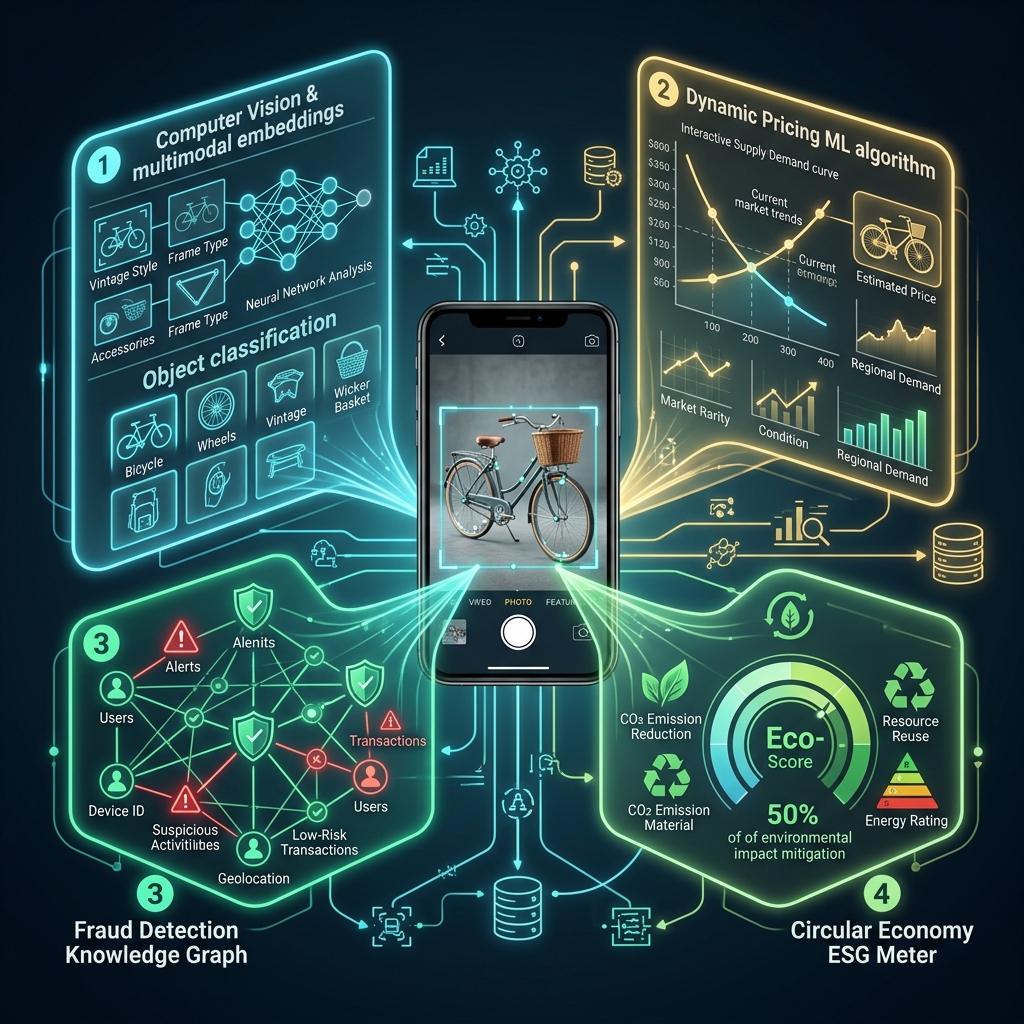
The 4 Pillars of Wallapop’s Machine Learning Architecture
Operating a marketplace where millions of non-professional users upload uncurated photos daily (poor lighting, out-of-focus shots, cluttered backgrounds) and incomplete descriptions is a formidable data engineering challenge. Wallapop solves this through four core technological engines:
1. Multimodal Visual Search and Embeddings
When a user searches for “vintage leather motorcycle jacket” or uploads a picture of a designer chair without knowing the manufacturer’s name, the search engine cannot rely on keyword matching alone.
Wallapop utilizes deep Convolutional Neural Networks (CNNs) and Vision Transformers (ViT) combined with multimodal foundation models (similar to CLIP) that project images and text into a shared high-dimensional vector space.
- Every uploaded photograph is vectorized into a dense embedding capturing texture, geometry, brand cues, and color palette.
- Using approximate nearest-neighbor vector indexes (such as the HNSW graphs we analyzed in PostgreSQL with pgvector), the platform returns visually identical or style-matched listings in under 15 milliseconds.
- The model executes automated attribute and category extraction: recognizing whether an item is a road bike, a bass guitar, or mid-century furniture, suggesting taxonomy labels to the seller with zero manual effort.
2. Algorithmic Dynamic Pricing and Market Elasticity
One of the primary friction points in C2C marketplaces is pricing uncertainty: sellers overestimate item value due to emotional attachment, while buyers ignore overpriced listings.
Wallapop deploys an algorithmic pricing Machine Learning engine trained on over a decade of real transactional records (actual agreed transaction values from payment pipelines and chat closures, not merely listed asking prices):
- The model calculates price-demand elasticity based on local inventory density within the user’s city and the detected physical condition of the item.
- It presents sellers with real-time guidance: a “Fast Sale” price band (expected sale in <48 hours) versus a “Fair Market” band (7–14 days), dramatically improving overall catalog liquidity.
3. Real-Time Fraud Prevention via Knowledge Graphs
In peer-to-peer commerce, trust is the fundamental operating infrastructure. Marketplaces battle constant adversarial pressure: counterfeit luxury goods, phishing schemes attempting to divert transactions off-platform, and automated account farming.
To neutralize fraud without introducing friction for legitimate buyers and sellers, Wallapop merges Natural Language Processing (NLP) with Knowledge Graph analytics:
- The system models users, phone numbers, credit card tokens, IP ranges, device hardware fingerprints, and chat sessions as interconnected nodes and edges in a live graph database.
- If a newly created account exhibits topological graph proximity or fingerprint overlap with a known fraudulent cluster, graph community detection algorithms isolate the account and flag listings before they become publicly searchable.
- Real-time NLP filters inspect in-app chat streams to warn users instantly if an unverified account attempts to solicit external wire transfers or phone numbers.
4. Quantified ESG Environmental Accounting
Unlike traditional retail marketplaces that accelerate linear consumption, Wallapop operates on the principles of the circular economy: every pre-owned transaction prevents the extraction of virgin materials, industrial manufacturing emissions, and international freight transport.
To convert this ecological mission into auditable, data-backed enterprise metrics (in direct philosophical alignment with Clarity AI), Wallapop developed a rigorous environmental impact methodology:
- Linking transacted product categories with international Life Cycle Assessment (LCA) environmental databases, the platform continuously computes net savings in CO₂ emissions, water consumption, and industrial waste.
- Over recent years, transactions on Wallapop have avoided hundreds of thousands of tons of CO₂ emissions, embedding sustainability as a core operational Key Performance Indicator (KPI).
Comparative Analysis: Spanish Tech Startups Profiled on Datalaria
With the addition of Wallapop, the landscape of Spanish technology pioneers analyzed on this blog represents a comprehensive cross-section of deep-tech engineering and data platforms:
| Company | Founded / HQ | Core Technology Domain | Business Model | Key Corporate Milestone |
|---|---|---|---|---|
| Devo | 2011 / Madrid–Boston | Petabyte-scale real-time log ingestion and cybersecurity analytics | B2B SaaS Enterprise / SIEM | Spanish Unicorn ($1.5B+ valuation) |
| Flywire | 2011 / Valencia–Boston | Complex cross-border payment processing with ML routing | B2B2C Fintech (Education, Healthcare, Travel) | Publicly listed on NASDAQ ($FLYW) |
| Carto | 2012 / Madrid–NY | Geospatial analytics (Location Intelligence) & Spatial SQL | B2B Cloud Data Analytics | Global market leader in spatial intelligence |
| Clarity AI | 2017 / Madrid–NY | AI-driven ESG scoring and sustainability impact analytics | B2B SaaS Fintech / Impact Investing | Global strategic partnerships with BlackRock & BNP Paribas |
| Nextail | 2014 / Madrid | Retail inventory optimization using prescriptive analytics | B2B SaaS Retail / Supply Chain | Deployed across global retailers in 30+ countries |
| Freepik | 2010 / Málaga | Creative asset platform and foundational GenAI vision models | B2C/B2B Freemium / GenAI | Acquired by EQT, worldwide leader in digital assets |
| Multiverse Computing | 2019 / San Sebastián | Quantum tensor network algorithms for LLM model compression | B2B Deep Tech / Quantum Computing | European leader in industrial quantum software |
| Wallapop | 2013 / Barcelona | Computer vision, dynamic pricing, and knowledge graphs in circular commerce | C2C/B2C Marketplace / Integrated Logistics | Majority acquisition by NAVER (>€800M) |
5 Engineering and Product Lessons from Wallapop
Wallapop’s trajectory offers enduring insights for engineers, data architects, and product managers:
1. Design for Zero Friction at Data Ingestion
Wallapop’s initial breakout was not driven by its search algorithm; it was driven by reducing listing creation to three taps on a mobile screen. If data intake is painful, your catalog stagnates. All subsequent machine learning sophistication depends upon frictionless data capture at the source.
2. Treat Trust as Core Infrastructure
In distributed C2C ecosystems, trust cannot be an afterthought handled by manual moderators. Building native knowledge graphs, tokenized payment escrow, and real-time behavioral monitoring into the core architecture is what allows a platform to scale safely to 19 million users.
3. Prioritize Real-Time, Low-Latency ML
A computer vision model or pricing algorithm that takes 3 seconds to respond degrades the mobile experience. Optimizing models through quantization, robust MLOps pipelines, and high-performance vector retrieval is the bridge that separates theoretical prototypes from production software.
4. Hyperlocality Builds Unassailable Network Effects
Global e-commerce behemoths commanded billions in capital, yet they could not match the dense hyperlocal liquidity of users trading within a single neighborhood in Madrid, Barcelona, or Milan. Local network effects create defensive moats that capital alone cannot buy.
5. Back Sustainability with Hard Data
Circular economy claims resonate only when substantiated by rigorous, auditable data. Quantifying environmental impact via structured LCA accounting turns sustainability from a marketing slogan into a competitive product moat and regulatory compliance asset under the EU AI Act.
Conclusion
Wallapop is compelling proof that the most transformative technology is that which disappears entirely into the user experience. Behind every neighborhood transaction for a second-hand espresso machine or a vintage road bike lies an invisible, high-throughput ecosystem of computer vision, distributed knowledge graphs, and predictive intelligence.
Its acquisition by NAVER not only crowns one of Spain’s most inspiring entrepreneurial journeys, but also confirms that the convergence of applied artificial intelligence, circular sustainability, and mobile-native user experience is the definitive model shaping the future of global digital commerce.
Sources of Interest:
- Wallapop: Press Room — South Korean Internet Giant NAVER Acquires Wallapop
- YouTube: The History and Acquisition of Wallapop
- Wallapop About: Brand Book and Corporate Identity
- Datalaria: Clarity AI — The ESG Sustainability Revolution
- Datalaria: Flywire — The Spanish Fintech Powering Global Payments
- Datalaria: Devo — Massive Data Ingestion and Cybersecurity Analytics
- Datalaria: Nextail — Prescriptive Analytics and Retail Inventory
- Datalaria: Carto — Location Intelligence and Spatial Analytics
- Datalaria: PostgreSQL with pgvector vs Vector DBs
- Datalaria: MLOps for Engineers — From Jupyter to Production
- Datalaria: EU AI Act — Practical Guide for Engineers