It is 6:15 AM on a Texas interstate highway. An independent truck driver hauling 20 tons of temperature-controlled produce receives an inbound call on his hands-free cab headset.
On the other end of the line, a natural, fluid, and professional voice asks for his current coordinates, verifies trailer reefer temperatures, and confirms whether he will hit his 9:30 AM delivery window at a Dallas distribution hub. The driver responds over the deafening hum of a diesel engine: in a thick regional drawl, he explains that he encountered highway construction delays on I-35 and will likely arrive forty minutes late.
Without a hesitation or awkward robotic delay, the voice instantly calculates the downstream schedule impact, reassures him, and reassigns his drop-off to dock door #4 to avoid warehouse congestion. The entire call concludes in exactly 48 seconds.
What makes this interaction extraordinary is that no human dispatcher was sitting on the other end of the line. It was an autonomous voice agent built by HappyRobot.
Before the driver even hung up his headset, the voice agent had transcribed the streaming audio, processed the driver’s mid-sentence interruption, executed two bi-directional API calls into the company’s Transportation Management System (TMS), updated the inventory records in SAP, and dispatched an automated SMS notification to the receiving dock supervisor.
Following our technical case studies on Wallapop in circular marketplaces, Devo in petabyte-scale data ingestion, Clarity AI in ESG sustainability intelligence, and Nextail in retail inventory optimization, this article analyzes the remarkable trajectory of HappyRobot: the startup that transformed the phone call — the most analogue, chaotic, and stubborn operational bottleneck in physical commerce — into a $1.2 billion enterprise artificial intelligence powerhouse.
The Origin: From Munich Classrooms to Y Combinator
The logistics industry moves more than 10% of global GDP, yet its day-to-day operations still rely heavily on a surprisingly archaic technology: the traditional phone call. Every day, hundreds of thousands of dispatchers and freight brokers spend between 6 and 8 hours on the phone executing low-cognitive-density tasks: check calls to track truck locations, freight rate bidding, dock appointment rescheduling, and invoice reconciliation.
For decades, enterprise software providers attempted to digitize this ecosystem through web portals and mobile applications. They largely failed because of a fundamental physical constraint: a driver operating an 80,000-pound semi-truck cannot interact with web forms on a smartphone; they need to speak.
HappyRobot’s founders recognized this operational reality from first principles:
- Pablo Palafox (CEO): Undergraduate degree in Robotics and Electronics, Master’s in Mechanical Engineering from the Technical University of Munich (TUM), and a PhD in 3D Computer Vision from one of Germany’s premier AI laboratories.
- Javier Palafox (COO): Pablo’s brother, bringing a strong background in finance, unit economics, and operational scaling.
- Luis Paarup (CTO): Pablo’s close engineering collaborator since their second day of university and fellow TUM Mechanical Engineering Master’s alumnus.
Assembling in 2022, the founders realized that the advent of Large Language Models (LLMs) presented an unprecedented opening: constructing an AI-native operating system designed specifically to listen, reason, and act within the physical, real economy.
Backing this vertical thesis, the company earned selection into the prestigious Y Combinator Summer 2023 batch (YC S23), relocating to San Francisco and quickly capturing the attention of top-tier Silicon Valley investors.
Capital Expansion and the Unicorn Milestone ($1.2B)
HappyRobot’s expansion over the past three years followed a steep trajectory, backed by tier-one venture capital firms across North America and Europe:
- Seed & YC Stage (2023): Early backing from seed powerhouses, including Andreessen Horowitz (a16z) and European venture firm Samaipata, enabling the team to deploy initial enterprise pilots across US freight brokerages.
- Series A & B (2024–2025): Consecutive growth rounds totaling $44 million (covered by Reuters and The Information), allocated toward engineering hiring and native integrations with dominant TMS ecosystems (McLeod, MercuryGate, Descartes).
- Series C and Unicorn Valuation (2026): In August 2026, HappyRobot announced a landmark $150 million Series C funding round led by Prysm Capital with co-leadership from Eurazeo, vaulting the company to an official $1.2 billion valuation and establishing HappyRobot as one of the fastest-scaling European-founded AI unicorns in recent history (featured on the cover of Fortune).
A foundational pillar of this commercial velocity was the company’s aggressive deployment of Forward Deployed Engineers (FDEs), a model pioneered by Palantir: rather than selling off-the-shelf software remotely, HappyRobot embeds software engineers directly into customer freight hubs to configure workflows, handle edge cases, and map business logic on the ground.
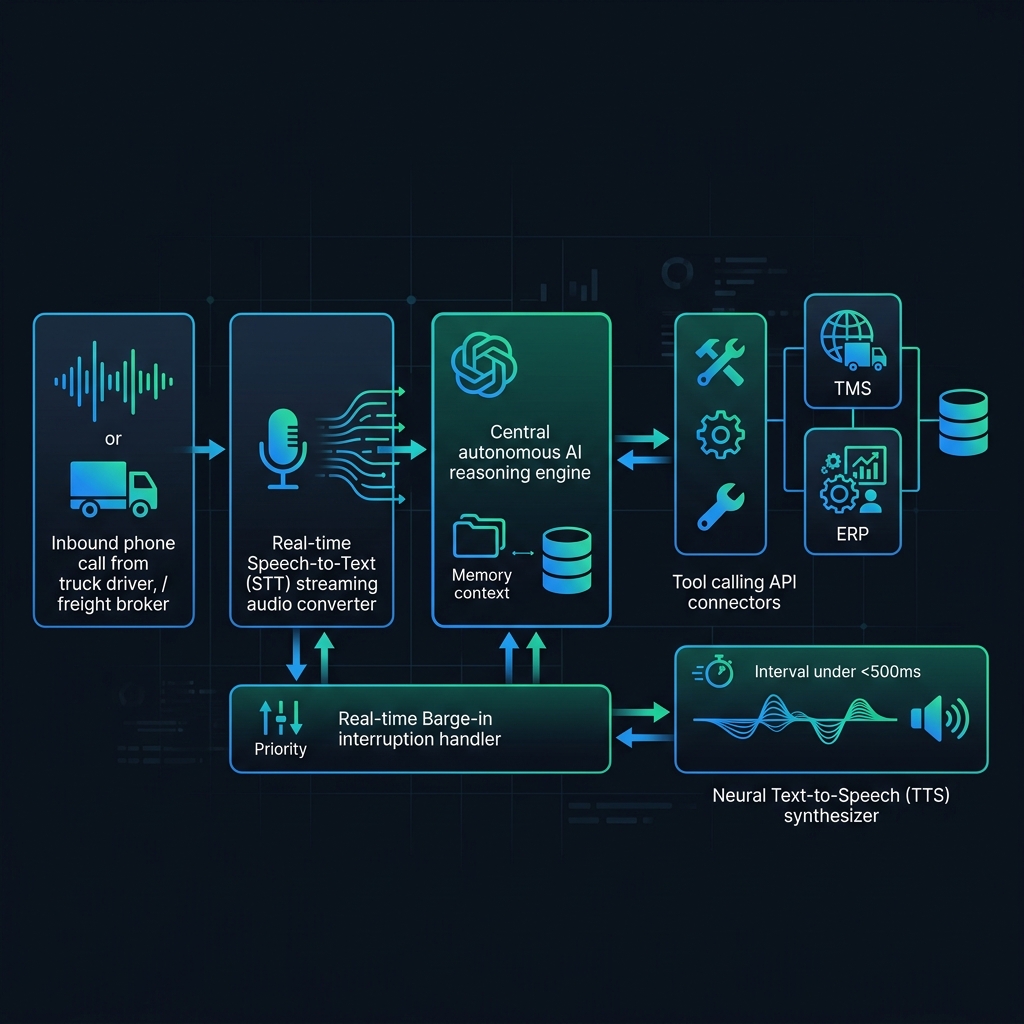
Real-Time Voice AI Technical Architecture
Engineering a voice agent for live phone calls across enterprise telephony networks is orders of magnitude more challenging than building a text chatbot. HappyRobot structured its platform across four synchronized architectural pillars:
1. End-to-End Telephony and Sub-500ms Latency
In natural human conversation, a latency gap exceeding 600 milliseconds causes conversational friction, leading both parties to speak over one another. On traditional carrier telephony networks (SIP/VoIP trunks), packet round-trip delays already consume 150 to 200 ms.
HappyRobot engineered its end-to-end processing pipeline to respond in under 450 milliseconds:
$$\text{Total Latency} = T_{\text{Audio In}} + T_{\text{STT Stream}} + T_{\text{LLM First Token}} + T_{\text{TTS Stream}} + T_{\text{Audio Out}} < 500\,\text{ms}$$To achieve this threshold, the system does not wait for a human speaker to finish a full sentence. Instead, it utilizes continuous streaming Speech-to-Text (STT) engines that evaluate phoneme streams and predict semantic intent while audio packets are still arriving over the socket.
2. Deterministic Real-Time Interruption Handling (Barge-In)
Freight conversations are inherently unstructured; drivers frequently interrupt (“Wait, scratch that, I took exit 42 instead”). If an AI agent continues speaking over the user, the interaction fails.
HappyRobot deploys low-latency local audio classifiers to differentiate between relevant spoken interjections and ambient cab noise (rumble strips, engine revs, radio music). When human speech is detected, the agent cuts audio output instantly (deterministic barge-in) and re-prompts the reasoning engine with the updated context.
3. Bi-Directional Tool Calling and Workflow Logic
The underlying language model is not a passive conversational interface; it is an active execution engine operating via dynamic Tool Calling, closely aligned with the agentic frameworks we explored in our Autopilot series and the Model Context Protocol (MCP).
Across a single 60-second dispatch call, an agent can check warehouse inventory, evaluate rate floors, verify dock appointment slots, and commit transaction logs into enterprise databases without requiring post-call human data entry.
4. Domain Adaptation and Cab Acoustic Resilience
Freight transportation employs heavy jargon and dense acronyms (deadhead miles, reefer breakdown, lumper fees, dry van, BOL). Standard off-the-shelf models from OpenAI or Anthropic struggle to accurately transcribe these terms under heavy regional accents and background engine noise. HappyRobot trains LoRA domain adapters across its speech recognition and language models to achieve over 98.5% recognition accuracy in acoustically hostile cab environments.
Current Operations: Enterprise Roster and Industry Diversification
Today, HappyRobot employs more than 80 engineers and operators and manages millions of live calls per month for over 150 enterprise clients, including:
- DHL Supply Chain: Global automation of delivery verifications and facility scheduling.
- Schneider & Werner Enterprises: Two of North America’s largest commercial fleets, running automated load tracking and exception management.
- Uber Freight & Kuehne+Nagel: Deploying voice agents for real-time load matching, dynamic rate negotiation, and spot freight coverage.
While logistics served as its foundational beachhead, the 2026 Series C expansion is actively accelerating HappyRobot’s horizontal deployment into other communications-heavy, mission-critical operational sectors: airlines, utilities, insurance claims, commercial banking, telecom, and automotive manufacturing.
Comparative Landscape: High-Tech Pioneers Profiled on Datalaria
With the addition of HappyRobot, the portfolio of high-impact technology leaders analyzed on Datalaria showcases the full spectrum of contemporary data engineering and enterprise software:
| Company | Founded / HQ | Core Technology Domain | Business Model | Notable Milestone |
|---|---|---|---|---|
| Devo | 2011 / Madrid–Boston | Petabyte-scale real-time log ingestion & cloud SIEM | B2B SaaS Enterprise | Unicorn ($1.5B+ valuation) |
| Flywire | 2011 / Valencia–Boston | Complex cross-border payment rails with ML routing | B2B2C Fintech | Publicly traded on NASDAQ ($FLYW) |
| Carto | 2012 / Madrid–NY | Geospatial analytics (Location Intelligence) & Spatial SQL | B2B Cloud Data Analytics | Global leader in spatial intelligence |
| Clarity AI | 2017 / Madrid–NY | AI-driven ESG scoring & environmental impact analytics | B2B SaaS Fintech | Partnerships with BlackRock & BNP Paribas |
| Nextail | 2014 / Madrid | Retail inventory optimization using prescriptive analytics | B2B SaaS Retail / Supply Chain | Deployed across 30+ countries |
| Freepik | 2010 / Málaga | Foundational generative AI vision models & creative assets | B2C/B2B Freemium / GenAI | Majority acquisition by EQT |
| Multiverse Computing | 2019 / San Sebastián | Quantum tensor networks for LLM compression & inference | B2B Deep Tech Quantum | European leader in industrial quantum software |
| Wallapop | 2013 / Barcelona | Computer vision, dynamic pricing & circular marketplaces | C2C/B2C Marketplace | Majority acquisition by NAVER (>€800M) |
| HappyRobot | 2022 / SF–Madrid | Autonomous real-time voice agents for enterprise operations | B2B SaaS Enterprise / Voice AI | Unicorn ($1.2B valuation, Series C) |
5 Engineering and Product Lessons from HappyRobot
HappyRobot’s trajectory provides enduring takeaways for engineering leaders and AI product builders:
1. Automate Where the Friction Lives, Not Where the Code is Easy
Many generative AI startups defaulted to chat interfaces because they are trivial to build using generic APIs. HappyRobot succeeded because it tackled the most intimidating medium: live, low-latency telephony audio burdened by background noise. Mastering the hardest channel creates an insurmountable market moat.
2. Treat Latency as a Core Product Feature
In voice systems, an added half-second delay completely shatters conversational trust. Prioritizing end-to-end latency as an architectural constraint from day one is what allowed HappyRobot to outmaneuver generalist competitors.
3. Forward Deployed Engineering Beats Ivory Tower Research
Pure algorithmic excellence fails if it ignores operational nuance. Placing software engineers directly on shipping docks to listen to dispatchers and truck drivers built domain understanding that Silicon Valley competitors could never replicate from a remote office.
4. Integrate Legacy-First
In the physical economy, enterprise customers will not dismantle a twenty-year-old SAP or AS/400 deployment to accommodate a new AI vendor. An autonomous agent’s enterprise value is directly proportional to its ability to interface with legacy infrastructure without operational friction.
5. Architect for the Exception, Not the Happy Path
In real-world logistics, the vast majority of calls occur precisely because something went wrong (flat tires, traffic jams, incorrect gate codes). True engineering resilience lies in how gracefully a system handles ambiguity, resolves conflict, and executes deterministic escalation to human teams when appropriate.
Conclusion
HappyRobot provides definitive proof that the most transformative artificial intelligence is not that which generates artistic images or drafts generic essays, but that which resolves the invisible, high-friction bottlenecks of the physical economy.
By restoring the human voice to the forefront of digital automation, Pablo Palafox, Javier Palafox, and Luis Paarup have shown that AI agents exist not to alienate human workers behind complex dashboards, but to liberate operational teams from millions of hours of mechanical tedium.
Their journey from the academic laboratories of Munich and Y Combinator to a $1.2 billion unicorn valuation cements another proud chapter in the global technology honor roll.
Sources of Interest:
- HappyRobot: Official Newsroom & Company Portal
- Fortune: HappyRobot is worth $1.2 billion. Its founder says it’s just ‘getting started’
- YouTube: How HappyRobot Automates Transactional Freight Calls
- Y Combinator: HappyRobot Company Profile (YC S23)
- Reuters: HappyRobot raises funding to expand AI agents for freight operators
- Datalaria: Wallapop — The Invisible Engineering Behind Europe’s Largest Circular Marketplace
- Datalaria: Devo — Massive Data Ingestion and Cybersecurity Analytics
- Datalaria: Clarity AI — The ESG Sustainability Revolution
- Datalaria: Nextail — Prescriptive Analytics and Retail Inventory
- Datalaria: Autopilot Series — Autonomous Agent Orchestration
- Datalaria: MCP Protocol — The Connection Standard for AI