In the academic corridors of Princeton during the 1940s and 1950s, a celebrated remark circulated from theoretical physicist Eugene Wigner, future Nobel laureate and childhood friend of our subject:
“I have known many intelligent minds in my life: I worked closely with Max Planck, Max von Laue, and Albert Einstein himself. But Paul Dirac was a genius, and Johnny von Neumann was simply of another species. Only Johnny was fully awake.”
Hans Bethe, head of the theoretical division at Los Alamos and also a Nobel laureate in Physics, pushed the sentiment even further, bordering on biological bewilderment: “I have sometimes wondered whether a brain like von Neumann’s does not indicate a species superior to that of man.”
They were not exaggerating. That short, slightly plump gentleman in an immaculate three-piece banker’s suit—which he wore even while riding a mule down the Grand Canyon—with a booming laugh, a passion for fast limousines, and an appetite for loud Princeton cocktail parties, possessed a cognitive processing power that defied any standard metric.
His name was János Lajos Neumann, immortalized worldwide as John von Neumann (or simply Johnny to his peers).
Today, every smartphone in our pockets, every cloud server, every supercomputing cluster training frontier models such as Gemini or Claude, and every reinforcement learning self-play algorithm rests directly upon the mathematical and architectural foundations that he drafted in barely three decades of tireless intellectual creation.
Continuing our series on pioneering thinkers at Datalaria—including Ada Lovelace, Alan Turing, Claude Shannon, Thomas Bayes, and J. Robert Oppenheimer—this article explores the astonishing life of John von Neumann, his foundational contributions to computing, the notorious “bottleneck” that now throttles modern AI hardware, and the historic prophecy in which he coined, for the first time in human history, the concept of the Technological Singularity.
The Budapest Prodigy and “The Martians”
Born in Budapest in December 1903 into a wealthy, non-practicing Jewish banking family, young János exhibited early signs of a terrifying mental prowess:
- Lightning mental calculation: By age six, he could mentally divide two eight-digit numbers in seconds and banter with his father in classical Greek about ancient Roman history.
- Total eidetic memory: He could read a page from a telephone directory or an entire chapter of Goethe’s Faust in German and recite it verbatim decades later. If prompted, he could translate it on the fly into English or French without the slightest hesitation.
- The dual-degree compromise: His pragmatic father, ennobled with the title of Margittai, worried that pure mathematics would not provide a stable living. As a compromise, Johnny enrolled simultaneously in Chemical Engineering at the prestigious ETH Zurich and a Ph.D. in Mathematics at the University of Budapest. By age twenty-two, he had graduated with top honors from both institutions—having attended virtually zero lectures in Hungary, showing up merely to ace the final exams.
Von Neumann belonged to an unrepeatable cluster of Hungarian-Jewish scientific luminaries who emigrated to the United States before the rise of European fascism, including Leo Szilard, Edward Teller, Eugene Wigner, and Theodore von Kármán. The group was so formidable and worked with such uncanny intellectual velocity that Enrico Fermi famously joked at Los Alamos: “Martians are already here among us; they just call themselves Hungarians and speak with a strange accent.” They were universally known as “The Martians” (A marslakók).
By the late 1920s in Göttingen and Berlin, von Neumann established the rigorous mathematical foundations of quantum mechanics in his seminal 1932 treatise, providing the Hilbert space framework that physicists still rely on today. But his most transformative contribution to civilization was waiting in the realm of computing.
The Von Neumann Architecture (1945): The Silicon Blueprint
In mid-1944, while waiting for a train on a platform at Aberdeen Proving Ground (Maryland), von Neumann struck up a casual conversation with Lieutenant Herman Goldstine, a military mathematician assigned to the top-secret ENIAC (Electronic Numerical Integrator and Computer) project at the University of Pennsylvania.
When Goldstine mentioned that the army was constructing an electronic behemoth capable of computing 5,000 additions per second using 18,000 vacuum tubes, von Neumann’s curiosity was instantly electrified.
The ENIAC was a masterpiece of ballistic calculation, but it suffered from a crippling operational handicap: it lacked an internal program. To switch from an artillery trajectory calculation to a shockwave propagation equation, a team of women engineers had to spend days physically unplugging patch cables, rewiring circuit boards, and resetting banks of mechanical dials. The machine was programmable in theory, but concrete-rigid in practice.
Von Neumann immediately joined the team as a consultant for the design of the next-generation machine: the EDVAC (Electronic Discrete Variable Automatic Computer).
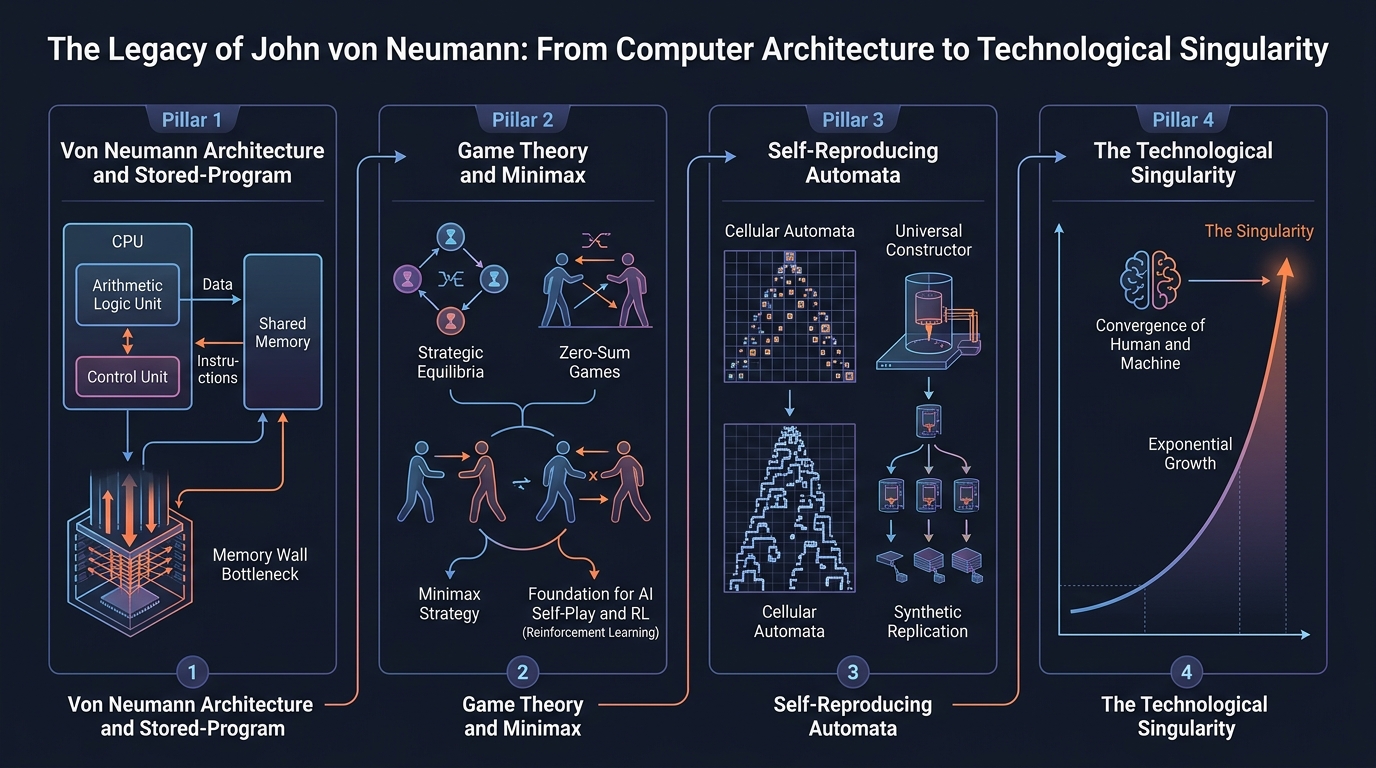
In June 1945, von Neumann authored a 101-page foundational document titled First Draft of a Report on the EDVAC. That single handwritten text laid down the universal structural blueprint that has governed virtually every computer built for the past eighty years: the stored-program computer.
+-----------------------------------------------------------+
|                   VON NEUMANN SYSTEM                      |
|                                                           |
|  +--------------------+        +-----------------------+  |
|  |   CPU              |        |     MAIN MEMORY       |  |
|  |  +--------------+  |  Bus   |  +-----------------+  |  |
|  |  | Control Unit |<===========> | Data            |  |  |
|  |  +--------------+  |        |  +-----------------+  |  |
|  |  | ALU          |  |        |  | Instructions    |  |  |
|  |  +--------------+  |        |  | (Shared Space)  |  |  |
|  |  | Registers    |  |        |  +-----------------+  |  |
|  +--------------------+        +-----------------------+  |
|           ^                                               |
|           | I/O Bus                                       |
|           v                                               |
|  +--------------------+                                   |
|  | Input / Output     |                                   |
|  +--------------------+                                   |
+-----------------------------------------------------------+
His breakthrough was as elegant as it was radical: treat program instructions using the exact same binary format as numerical data, residing together inside a single, homogeneous memory space.
Suddenly, a computer no longer required manual rewiring: a program was simply a sequential array of numbers loaded into memory that the Control Unit could read, decode, and execute, branching or dynamically modifying its own instructions at runtime.
The canonical architecture consists of four distinct subsystems:
- Central Processing Unit (CPU): Containing the Arithmetic Logic Unit (ALU) for arithmetic and logical operations, alongside high-speed internal registers.
- Control Unit (CU): Responsible for fetching instructions sequentially from memory and orchestrating execution.
- Shared Primary Memory: Storing both executable binary instructions and runtime variable data.
- Input/Output (I/O) Interfaces: Bridging the system with external sensors, displays, and storage.
While engineers John Mauchly and J. Presper Eckert (the builders of ENIAC) made crucial practical contributions, it was von Neumann’s mathematical formalization that codified the architecture and disseminated it worldwide.
The “Von Neumann Bottleneck” and the AI Memory Wall
The von Neumann architecture was an extraordinary triumph that sparked the digital revolution. Yet, embedded within its core design was a fundamental physical penalty known to computer architects as the Von Neumann Bottleneck (or the Memory Wall).
Because instructions and data must traverse the exact same shared bus connecting memory to the central processing unit, system throughput is fundamentally constrained not by how fast the CPU or GPU can calculate, but by the speed and bandwidth with which memory can supply operands.
[ CPU / GPU Tensor Cores ] <=== BOTTLENECK (Limited Bus Bandwidth) ===> [ HBM / DRAM Memory ]
       (Ultra-Fast)                      (High Latency & Heat)                 (Massive Storage)
For decades, multi-level caches (L1, L2, L3) and speculative branch execution mitigated the problem. However, in 2026, amid the explosion of multi-trillion parameter Large Language Models and supercomputing clusters for AGI, the von Neumann bottleneck has become an existential wall:
- In cutting-edge architectures like NVIDIA Blackwell (B200 / GB200) or Google TPU v6, energy consumption and operational latency are no longer driven by floating-point arithmetic (FP8/FP4 tensor math), but by shuffling trillions of parameter weights between High Bandwidth Memory (HBM3e/HBM4) and computing dies.
- As we examined in our recent deep dive on Submer, this ferocious movement of memory data generates thermal densities exceeding 100 kW per rack, forcing modern data centers to abandon air cooling in favor of single-phase dielectric liquid immersion.
- Simultaneously, the AI industry is aggressively investigating non-von-Neumann architectures: from Processing-in-Memory (PIM) and neuromorphic chips to streaming dataflow engines like LPUs (Language Processing Units), all striving to eliminate the physical boundary between calculation and storage that Johnny formalized eight decades ago.
Game Theory and Minimax: The DNA of Autonomous Agents
Had von Neumann only architected the modern computer, his place in the pantheon of science would be secure. Yet his mind was simultaneously pioneering entirely unrelated disciplines.
In 1928, fascinated by why games like poker depend on psychological bluffing and asymmetric information rather than combinatorial calculation like chess, he proved the celebrated Minimax Theorem.
The theorem demonstrated that in any finite, two-player zero-sum game, there always exists an optimal mixed strategy for each player that guarantees the best possible outcome against the opponent’s worst-case move.
In 1944, collaborating with Austrian economist Oskar Morgenstern, he published the landmark volume that founded an entire academic field: Theory of Games and Economic Behavior.
From Cold War Geopolitics to Frontier AI
Game theory revolutionized economics, but its most sobering immediate impact was in Cold War statecraft. As a key consultant to the RAND Corporation and the U.S. government, von Neumann applied game theory to model nuclear standoffs, formulating the foundational logic behind MAD (Mutually Assured Destruction).
For contemporary data scientists and AI engineers, Game Theory provides the native operating system of autonomous intelligence:
- Self-Play in Reinforcement Learning: The self-play training paradigm in which neural networks compete against mirror instances to explore immense state spaces—the core engine behind AlphaGo and AlphaZero, explored in The Thinking Game—is a direct computational realization of von Neumann’s minimax equilibria.
- System 2 Reasoning in Frontier Models: Contemporary reasoning models leverage guided search heuristics (such as Monte Carlo Tree Search and multi-agent debate) where utility functions and loss-minimization rules stem directly from game-theoretic frameworks.
- Probabilistic Decision-Making: Von Neumann’s formalization of expected utility closed the loop with Bayesian decision theory, as discussed in our study of Thomas Bayes, furnishing software agents with a rigorous framework for action under uncertainty.
Los Alamos, Oppenheimer, and the Monte Carlo Method
During World War II and the dawn of the Cold War, von Neumann was an indispensable scientific asset for the Manhattan Project at Los Alamos.
It was von Neumann who performed the complex hydrodynamic simulations proving the feasibility of the implosion lens for the Fat Man plutonium bomb—a problem of symmetric high-explosive compression so formidable that many senior physicists had deemed it unsolvable.
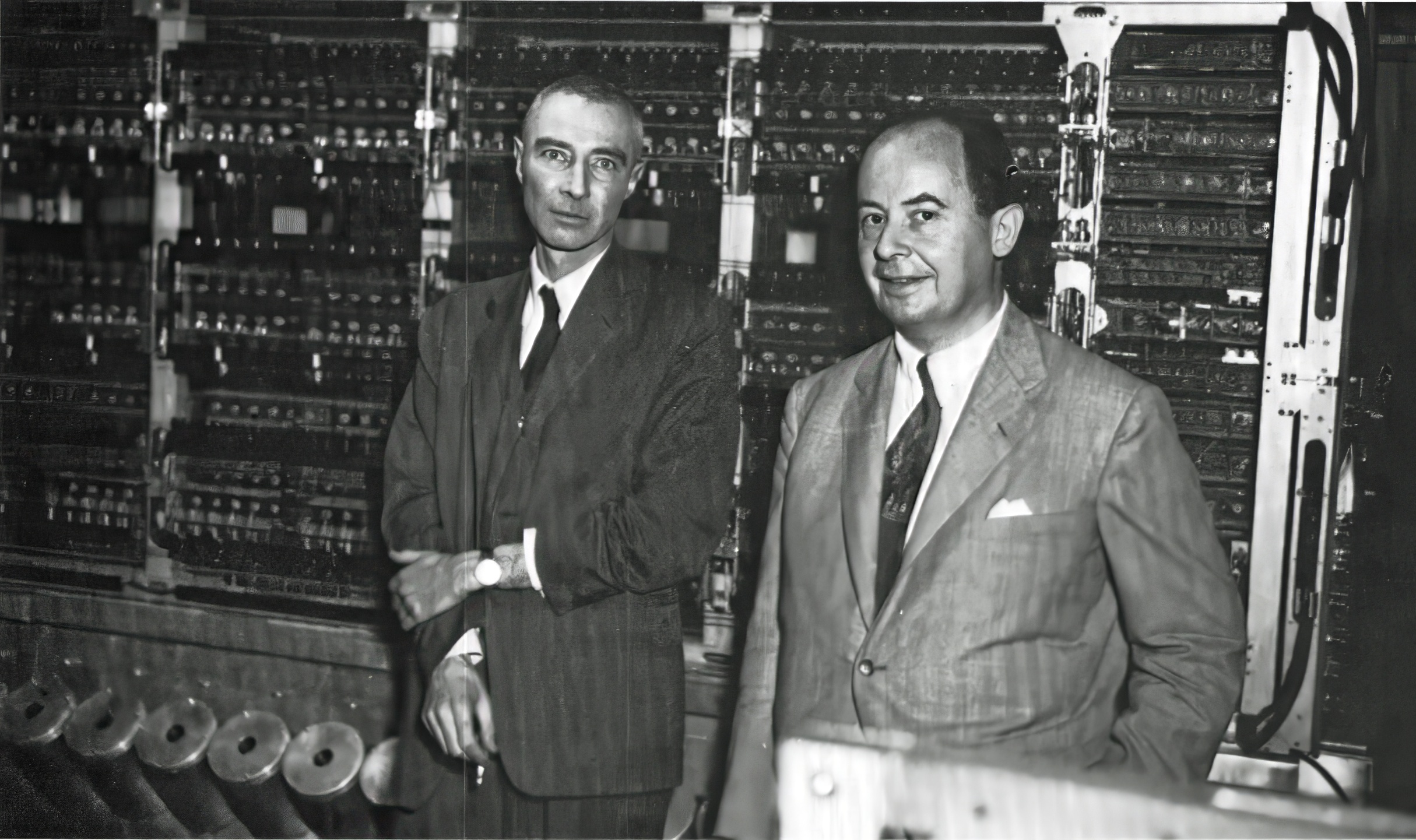
At Los Alamos, he forged a close intellectual partnership with J. Robert Oppenheimer and Polish mathematician Stanisław Ulam. As detailed in our Oppenheimer retrospective, when Ulam conceived the idea of solving intractable physical differential equations through pseudo-random card sampling experiments, it was von Neumann who translated that insight into an executable digital algorithm: the Monte Carlo Method.
To accelerate the grueling thermonuclear simulations for the hydrogen bomb, von Neumann oversaw the design and construction of the IAS Machine in Princeton, affectionately nicknamed MANIAC (Mathematical Analyzer, Numerical Integrator and Computer).
His interactions with other historical icons of the era remain legendary:
- With Alan Turing: In 1938, von Neumann was so captivated by Turing’s paper on computable numbers that he offered him a position as his research assistant at the Institute for Advanced Study (IAS). Although Alan Turing declined to return to England, von Neumann always credited Turing’s Universal Machine as the conceptual spark behind the stored-program computer.
- With Claude Shannon: In 1948, when Claude Shannon was searching for a name for his mathematical measure of uncertainty at Bell Labs, he turned to von Neumann. Johnny offered a brilliantly mischievous recommendation: “You should call it entropy, for two reasons. First, your uncertainty function has been used in statistical mechanics under that name. Second, and more importantly: no one really knows what entropy is, so in a debate you will always have the advantage!”
- With Leonid Kantorovich: Von Neumann immediately recognized the breakthrough of Leonid Kantorovich and George Dantzig, formulating the Duality Theorem, which proved that linear optimization and two-person zero-sum game theory are mathematically identical duals of one another.
Cellular Automata and Self-Replicating Machines
In his final years, von Neumann’s restless intellect leapt decades ahead of molecular biology and artificial life.
Intrigued by discussions with neurophysiologist Warren McCulloch regarding how biological brains process reliable information out of faulty, noisy neurons, von Neumann tackled a profound mechanical question: Can a machine construct an exact duplicate of itself, or even create a machine more complex than itself?
In his posthumously published work Theory of Self-Reproducing Automata (1966), he mathematically demonstrated that artificial self-replication is entirely feasible. To prove it, he invented the concept of the Cellular Automaton: a discrete, infinite grid where each cell changes state based on local transitional rules (the direct forebear of John Conway’s celebrated Game of Life).
Within this framework, he designed the theoretical Universal Constructor, composed of three components:
- An instruction tape detailing the construction blueprint.
- A manufacturing mechanism that reads the tape and fabricates components.
- A copying mechanism that replicates the tape and deposits it into the newly born machine.
Remarkably, von Neumann constructed this logical architecture before James Watson and Francis Crick unraveled the double helix of DNA in 1953: he deduced from pure logic that biological organisms must decouple genetic blueprints (DNA) from active transcription and replication engines (ribosomes and polymerases).
In astrophysics, this insight inspired the concept of Von Neumann Probes: self-replicating robotic spacecraft capable of exploring and settling an entire galaxy within a few million years. And in the 2026 software landscape, his vision mirrors autonomous coding agents capable of inspecting their own source code, generating patches, self-compiling, and deploying optimized instances across cloud networks.
The True Origin of the “Technological Singularity”
It is widely assumed that the term “Singularidad” or “Technological Singularity” was coined by science fiction visionary Vernor Vinge in the 1990s or popularized by futurist Ray Kurzweil.
In reality, the concept’s documented genesis belongs to a private conversation between John von Neumann and his lifelong friend Stanisław Ulam in the mid-1950s.
In May 1958, in a memorial tribute published in the Bulletin of the American Mathematical Society, Ulam immortalized that prophetic exchange:
“One conversation centered on the ever accelerating progress of technology and changes in the mode of human life, which gives the appearance of approaching some essential singularity in the history of the race beyond which human affairs, as we know them, could not continue.”
This was the very first instance in intellectual history where the mathematical term singularity—a point where a curve shoots toward infinity and existing laws break down—was applied to human civilization under the relentless acceleration of computing and intelligent machines.
Von Neumann did not envision technology as a linear progression, but as an exponential feedback loop: machines designing superior machines, accelerating scientific discovery, compressing centuries of progress into decades, and decades into hours.
The Final Flight and the Mirror of AGI
In early 1955, von Neumann was diagnosed with aggressive bone and pancreatic cancer, likely exacerbated by his unshielded exposure to radiation during nuclear tests at Los Alamos and the Bikini Atoll.
During his final months at Walter Reed Army Medical Center in Washington, D.C., confined to bed under strict armed military guard out of fear that he might blurt out nuclear launch secrets during feverish delirium, Johnny faced his most agonizing struggle.
For a thinker whose entire identity was anchored in unrivaled cognitive agility, the slow degradation of his faculties was excruciating. His brother read Goethe aloud to him in German, while Johnny strained with fading breath to complete the lines before his energy gave out. He passed away on February 8, 1957, at just fifty-three years old.
Eighty years after the EDVAC report, the world we inhabit in 2026 has converged precisely onto the coordinates Johnny foresaw:
- His stored-program architecture processes every digital instruction of modern life.
- His game-theoretic equilibria and minimax self-play train frontier models like Gemini, Claude, and GPT.
- And the steepening exponential curve of technological progress is unmistakably driving humanity toward that essential singularity he contemplated on the Princeton lawn.
An Open Question for the Reader
John von Neumann was an incomparable intellectual force: a man whose computational brain was so extraordinary that his fellow geniuses suspected he belonged to an advanced species.
Yet he chose to dedicate that intellect to building the machine that would eventually challenge biological supremacy. He designed the hardware to make silicon think, the strategic rules for autonomous agents to compete, and the theoretical proof that machines could reproduce and evolve.
The question his life leaves echoing in 2026 is not about our history, but about our imminent future:
Was Johnny von Neumann the last universal polymath of our biological species… or the engineer who built the cradle for the first synthetic superintelligence that will cross the Singularity?
And when we step beyond that threshold he named… will we still understand how to play the game, or will we find that the board no longer belongs to us?
We would love to read your reflections. Share your thoughts in the comments below.
References and Further Reading:
- Ananyo Bhattacharya (2021): The Man from the Future: The Visionary Life of John von Neumann
- John von Neumann (1945): First Draft of a Report on the EDVAC — University of Pennsylvania
- John von Neumann & Oskar Morgenstern (1944): Theory of Games and Economic Behavior — Princeton University Press
- Stanisław Ulam (1958): John von Neumann 1903–1957 — Bulletin of the American Mathematical Society
- Datalaria: Alan Turing — The Genius Who Cracked Enigma and Asked if Machines Could Think
- Datalaria: J. Robert Oppenheimer — From Monte Carlo to the Ethical Dilemma of AGI
- Datalaria: Claude Shannon — The Father of Information Theory
- Datalaria: Thomas Bayes — Probabilistic Inference and the Weight of Evidence
- Datalaria: Leonid Kantorovich — Mathematical Optimization and Duality
- Datalaria: The Thinking Game — Demis Hassabis, DeepMind, and Self-Play
- Datalaria: Submer — The AI Thermal Wall and Liquid Immersion Cooling