In 1843, a 27-year-old mother of three and Countess of Lovelace published a technical appendix of notes three times longer than the original text she intended to translate. In those manuscript pages penned with quill and ink, in the heart of Victorian England’s age of coal and steam, Augusta Ada King, Countess of Lovelace, did not merely write the first computer algorithm in history designed to be processed by a machine. She accomplished something infinitely more revolutionary: she conceived the very concepts of software and general-purpose computing.
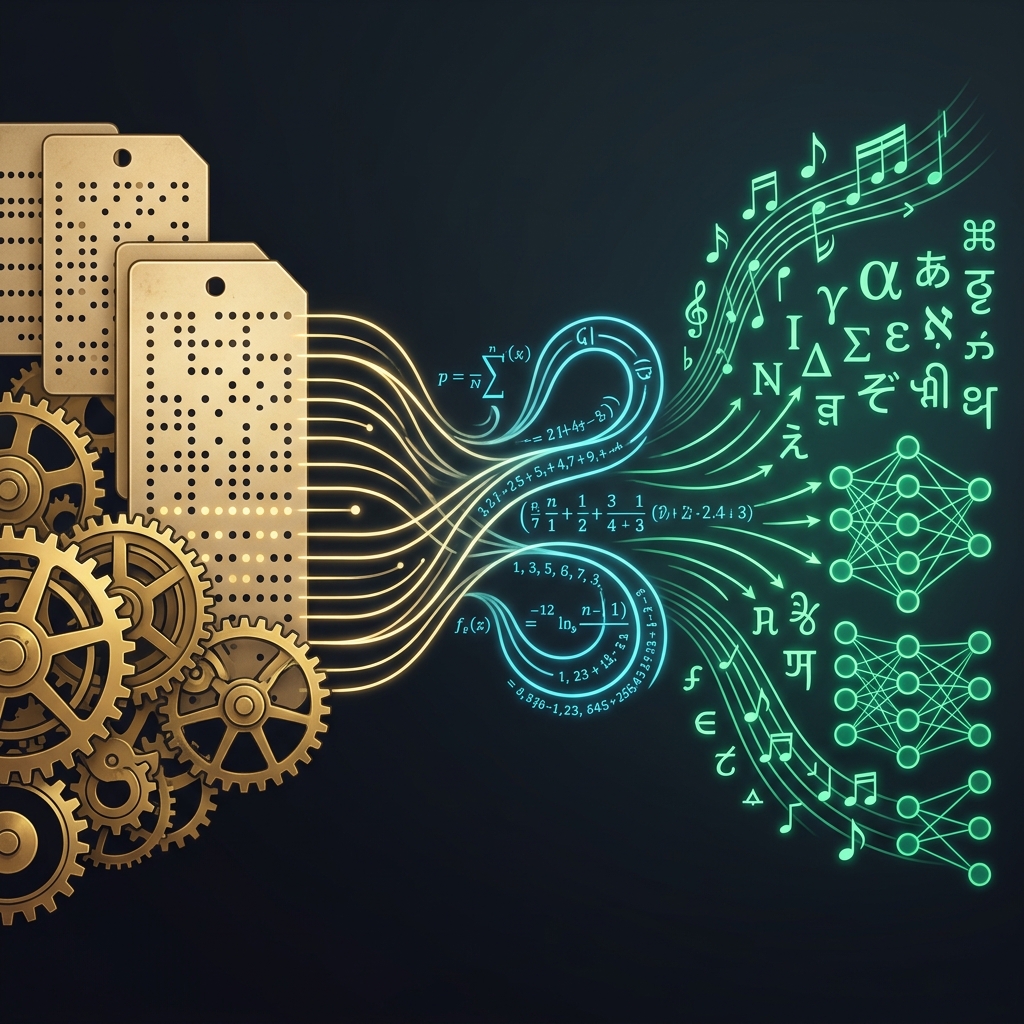
While her mentor and collaborator, the brilliant inventor Charles Babbage, remained obsessed with building a massive mechanical calculator of brass and gears to eliminate human errors in astronomical and maritime navigation tables, Ada Lovelace saw what no one else in the 19th century could perceive. She understood that if a machine could manipulate numbers, and those numbers could represent any real-world entity — musical notes, alphabet letters, or visual pixels —, the machine could manipulate symbols and generate art, language, and knowledge.
In the pantheon of pioneers who laid the foundations of our data-driven civilization — alongside Florence Nightingale and healthcare statistics, Thomas Bayes and probabilistic inference, Claude Shannon and information theory, and Abraham Wald and the analysis of missing data —, Ada Lovelace occupies the foundational place: she was the first person to grasp that hardware is merely the mechanical body, but the algorithm is the thinking soul of the system.
The Princess of Parallelograms: Education Against Madness
Ada Lovelace was born in London in December 1815 as the only legitimate child of the famed Romantic poet Lord Byron and the aristocratic mathematician Annabella Milbanke. The marriage was a volcanic catastrophe: Byron left England mere weeks after Ada’s birth never to return, leaving behind a wake of scandals, debts, and tempestuous genius.
Terrified that her daughter might inherit her father’s erratic temperament and “poetic madness,” Lady Byron subjected young Ada to an unusually rigorous educational regime for Victorian women. She banished poetry from their home and enforced an intensive diet of rigorous mathematics, logic, geometry, astronomy, and Latin. Annabella, whom Lord Byron himself had ironically dubbed in his letters as “the Princess of Parallelograms,” hired the finest private tutors in the British realm, including the renowned logician and mathematician Augustus De Morgan (famous for De Morgan’s Laws of Boolean algebra) and the astronomer and science writer Mary Somerville.
De Morgan quickly recognized that young Ada’s mind was extraordinary: she possessed an abstract ability to connect mathematical concepts with a philosophical and poetic intuition that he confessed he had never witnessed in any student. Ada herself coined her intellectual approach as “Poetical Science”: an integrative philosophy that applied metaphorical imagination to explore the deepest mathematical truths and discover practical applications where others saw only sterile figures.
Meeting Babbage: From Mechanical Calculator to Universal Computer
On June 5, 1833, at a London high-society salon, seventeen-year-old Ada was introduced to Charles Babbage, the Lucasian Professor of Mathematics at the University of Cambridge (the chair once held by Isaac Newton and later by Stephen Hawking). Babbage demonstrated to his guests a working partial prototype of his Difference Engine: a complex mechanical machine of brass gears designed to tabulate polynomials using the method of finite differences.
While most attendees viewed the contraption as a mechanical curiosity or an expensive scientific novelty, Ada was captivated by the underlying logical beauty of the mechanism. Thus began an epistolary correspondence and an intellectual partnership that spanned nearly two decades.
Soon, Babbage abandoned the Difference Engine to embark upon an incomparably more ambitious venture: the Analytical Engine. The difference between both machines is, in essence, the exact difference between a pocket calculator and a modern general-purpose computer:
- The Difference Engine was a single-purpose calculator: it could only add and subtract to compute pre-determined polynomial tables.
- The Analytical Engine was a programmable, general-purpose computing machine: it featured a central processing calculation unit Babbage called “the Mill,” a data storage memory unit called “the Store,” and an input/output control mechanism based on punched cards, inspired directly by Joseph Marie Jacquard’s 1804 automated textile loom.
Babbage designed the machine. But it was Lovelace who truly understood what it meant.
The 1843 “Notes” and the First Algorithm (Note G)
In 1842, Babbage traveled to Turin to deliver a series of lectures on the Analytical Engine. Italian military engineer and mathematician Luigi Menabrea (future Prime Minister of Italy) took detailed notes and published a French paper describing the engine’s operational principles in a Swiss journal.
Charles Wheatstone suggested that Ada Lovelace translate Menabrea’s paper into English for the academic journal Taylor’s Scientific Memoirs. Babbage, delighted with the prospect, encouraged her to add her own explanatory notes and commentaries. Ada worked relentlessly for nine months between 1842 and 1843, expanding the original text into a seminal work. Her annotations — labeled alphabetically from Note A to Note G — were more than three times longer than Menabrea’s original treatise.
In Note A, Ada articulated the technical and philosophical distinction separating mere calculation from universal computing. She wrote one of the most visionary sentences in scientific history:
“The Analytical Engine weaves algebraical patterns just as the Jacquard loom weaves flowers and leaves.”
Yet the climax of her masterpiece lies within the legendary Note G. In this section, Ada designed a complete, structured operational diagram to compute the Bernoulli numbers (a complex sequence of rational numbers fundamental to number theory and mathematical analysis).
This was not a simple table of arithmetic steps: it was a formal computer algorithm. Lovelace designed with clockwork precision:
- State variables and memory registers: She allocated specific memory addresses in the engine’s “Store” to track intermediate variables ($V_1, V_2, V_3 \dots$).
- Loops and iteration: She structured instructions allowing the machine to repeat sequences of punched cards automatically until an arithmetic condition was fulfilled.
- Conditional branching: She defined how the control flow of the program could divert based on the outcome of a prior calculation.
- Parallel execution and resource optimization: She analyzed how to minimize calculation cycles within the Mill to maximize computational efficiency.
Because of Note G, the international scientific community unanimously recognizes Ada Lovelace as the world’s first computer programmer.
The Leap to Symbolic Computation: Software Before Hardware
For Babbage, the Analytical Engine was a number-crunching apparatus: its goal was to accelerate astronomical calculations, ballistics tables, and financial ledger computation.
For Lovelace, numbers were merely the medium, not the ultimate destination. In Note A, Ada made the monumental conceptual leap that would take another century for John von Neumann and Alan Turing to rediscover:
“Supposing that the fundamental relations of pitched sounds in the science of harmony and of musical composition were susceptible of such expression and adaptations, the engine might compose elaborate and scientific pieces of music of any degree of complexity or extent.”
This insight is breathtaking. In 1843, in a world devoid of electricity, vacuum tubes, and silicon semiconductors, a mathematician realized that any information system capable of being formalized through logical rules can be manipulated, transformed, and generated by an algorithmic machine.
Ada envisioned software, digital audio synthesis, natural language processing, and computer graphics before the incandescent light bulb had even been invented. She decoupled symbolic content from physical hardware, exactly as Claude Shannon would decouple human meaning from the mathematical entropy of the bit a century later.
“Lady Lovelace’s Objection”: The Original AI Debate
In Note G, Ada contemplated the metaphysical and operational boundaries of intelligent machines, offering a cautionary observation that would shape the philosophy of artificial intelligence forever:
“The Analytical Engine has no pretensions whatever to originate anything. It can do whatever we know how to order it to perform. It can follow analysis; but it has no power of anticipating any analytical relations or truths.”
A century later, in 1950, the father of theoretical computing and AI pioneer Alan Turing published his landmark paper “Computing Machinery and Intelligence” (introducing the Turing Test). In that paper, Turing dedicated an entire section to examining what he formally named “Lady Lovelace’s Objection”.
Turing debated whether machines are truly incapable of surprising us or whether apparent creativity is simply an emergent property of extraordinarily complex deterministic rules executed at massive scale.
In 2026, in the midst of Large Language Models (LLMs) and autonomous reasoning agents powered by Gemini 2.5, Claude 3.7, and DeepSeek, Lovelace’s Objection remains at the very core of modern technological debate:
- When an agentic pipeline using CrewAI and Tool Calling autonomously resolves a complex supply chain crisis in our Obsolescence Radar, is it “creating” novel insight, or simply executing with statistical precision the trillions of conditioned parameters from its training?
- When we compare Fine-Tuning vs Prompt Engineering vs RAG, we are recognizing the practical validity of Lovelace’s postulate: the model does not conjure your company’s truth out of thin air; it requires injected deterministic context through tools and curated data to deliver dependable results.
The question Ada posed in 1843 remains the technical and ethical benchmark through which the EU AI Act mandates human oversight (Article 14): machines execute with unprecedented speed, but purpose, responsibility, and ultimate judgment remain human prerogatives.
The Legacy: From Steam Power to Mission-Critical Systems
Ada Lovelace tragically passed away from uterine cancer in November 1852 at just 36 years of age — the exact age at which her father, Lord Byron, had died — and was buried, per her wish, beside him at the Church of St. Mary Magdalene in Hucknall, Nottinghamshire.
Babbage’s Analytical Engine was never constructed during their lifetimes due to lack of government funding and the mechanical tolerance limits of Victorian metallurgy. For nearly a century, Lovelace’s work lingered as an obscure bibliographic footnote in British scientific annals.
Yet history ultimately rendered mathematical justice to her vision:
- The Ada Programming Language: In the late 1970s, the United States Department of Defense (DoD) commissioned a high-reliability, strongly typed programming language to manage mission-critical aerospace, defense, and infrastructure systems. In 1980, the DoD officially named the language Ada (military standard MIL-STD-1815, honoring her birth year). Today, Ada continues to control European air traffic management systems, French TGV high-speed trains, and commercial avionics flight control software worldwide.
- Ada Lovelace Day: Every second Tuesday of October, the global technology and scientific community celebrates Ada Lovelace Day to champion and elevate women’s leadership and achievements across STEM fields (Science, Technology, Engineering, and Mathematics).
- NVIDIA’s GPU Architecture: NVIDIA named its flagship GeForce RTX 40-series microarchitecture Ada Lovelace, paying tribute to the mathematician who first conceived of parallel algorithmic execution.
Thinking Like Ada: The Synthesis of Poetry and Engineering
If there is an enduring lesson Ada Lovelace bequeathed to software engineers, data scientists, and AI architects in our era, it is the power of Poetical Science.
Engineering devoid of imagination yields merely faster calculators; poetry without mathematical rigor produces fragile dreams with no practical foundation. But when rigorous mathematical discipline aligns with the bold imagination to envision how data reshapes human capability, revolutions occur.
Ada did not merely calculate polynomial series: she envisioned our digital future when the world still traveled on horseback. Two hundred years after her birth, every time we write a Python function, orchestrate an intelligent agent, or transform data pipelines into industrial decisions, we are walking along the pathway that a young Victorian mathematician charted on paper with ink, genius, and unmatched foresight.
Sources of Interest:
- The British Library: Ada Lovelace’s Mathematical Papers and Correspondence with Charles Babbage
- Taylor’s Scientific Memoirs (1843): Sketch of the Analytical Engine with Notes by the Translator
- Alan Turing (1950): Computing Machinery and Intelligence — Section on Lady Lovelace’s Objection
- Computer History Museum: The Babbage Engine & Lovelace Legacy
- Datalaria: Claude Shannon — The Man Who Turned the World into Bits
- Datalaria: Thomas Bayes — The Reverend Who Taught Us to Update Our Beliefs with Data
- Datalaria: Florence Nightingale — The Rose Diagram and Healthcare Statistics
- Datalaria: Abraham Wald — Survivorship Bias and Missing Data
- Datalaria: Fine-Tuning vs Prompt Engineering vs RAG