In the drafty corridors of Bletchley Park, the Victorian estate in Buckinghamshire where the British government secretly gathered the country’s sharpest mathematical minds during World War II, a young Cambridge don could frequently be seen riding a bicycle whose faulty chain slipped off after a precise number of gear revolutions. Rather than take it to a repair shop, the mathematician calculated the exact mechanical cycle of the defect, counted the rotations of the pedals in his head as he dashed along country lanes, and braked a split-second before the failure point to nudge the chain back onto the sprocket with his toe — never once dismounting from the saddle.
This was the same man who padlocked his personal tea mug to the radiator pipes in Hut 8 to prevent colleagues from borrowing it, ran marathons with times that nearly qualified him for the British Olympic team (clocking an astonishing 2 hours and 46 minutes, just eleven minutes behind the silver medalist at the 1948 London Olympic Games), and cycled to work in springtime wearing a military gas mask because he suffered from crippling hay fever.
His name was Alan Mathison Turing.
Universally revered as the father of modern computer science and theoretical Artificial Intelligence, Turing did far more than save an estimated 14 million lives by cracking Nazi Germany’s Enigma naval cipher. In 1950, when electronic computers were room-sized behemoths of vacuum tubes and humming circuitry, Turing posed the foundational question that defines our current technological epoch: “Can machines think?”.
Just as we explored in our historical portraits of Ada Lovelace, Claude Shannon, and Thomas Bayes, this article journeys through Turing’s life, his mathematical triumphs, and how his radical insights anticipated with uncanny precision today’s high-stakes debates over autonomous AI agents, security vulnerabilities in platforms like Hugging Face, and humanity’s threshold with Artificial General Intelligence (AGI).
From the Universal Machine to Bletchley Park: Engineering the Impossible
In 1936, at just 24 years of age, Turing published a monumental paper: “On Computable Numbers, with an Application to the Entscheidungsproblem”. In it, he demonstrated that there could be no universal algorithmic method for determining whether an arbitrary mathematical assertion was true or false.
To prove this impossibility, he conceived a brilliant theoretical abstraction: the Turing Machine. He imagined a simple device equipped with an infinite paper tape divided into squares, a read/write head, and a finite table of state instructions. With this elementary model, Turing proved that a single universal machine could simulate any mathematical computation imaginable, provided it received the proper algorithm and data on its tape. On paper and in ink, he had invented the stored-program digital computer a decade before the first physical hardware was ever constructed.
When war erupted in 1939, Turing reported to the ultra-secret government codebreaking station at Bletchley Park to confront the greatest cryptographic nightmare of the century: Enigma, the German military’s electromechanical rotor cipher machine capable of generating more than 150 trillion possible daily key configurations.
Turing recognized that no team of human cryptanalysts, however brilliant, could outpace the combinatorial explosion of a mechanical cipher engine. He designed the Bombe, a massive 12-ton electromechanical apparatus consisting of rotating cylindrical drums that simulated dozens of interconnected Enigma machines in parallel.
To accelerate the search and discard unpromising rotor combinations, Turing pioneered a mathematical technique called Banburismus, utilizing punched paper sheets manufactured in the town of Banbury. Remarkably, this technique rested upon the exact foundations of conditional probability and evidence updating we explored in our study of Thomas Bayes: Turing measured the weight of evidence supporting a hypothesis in logarithmic units he dubbed bans and decibans, direct conceptual ancestors to the bits and information entropy that his contemporary Claude Shannon would formalize at Bell Labs just five years later.
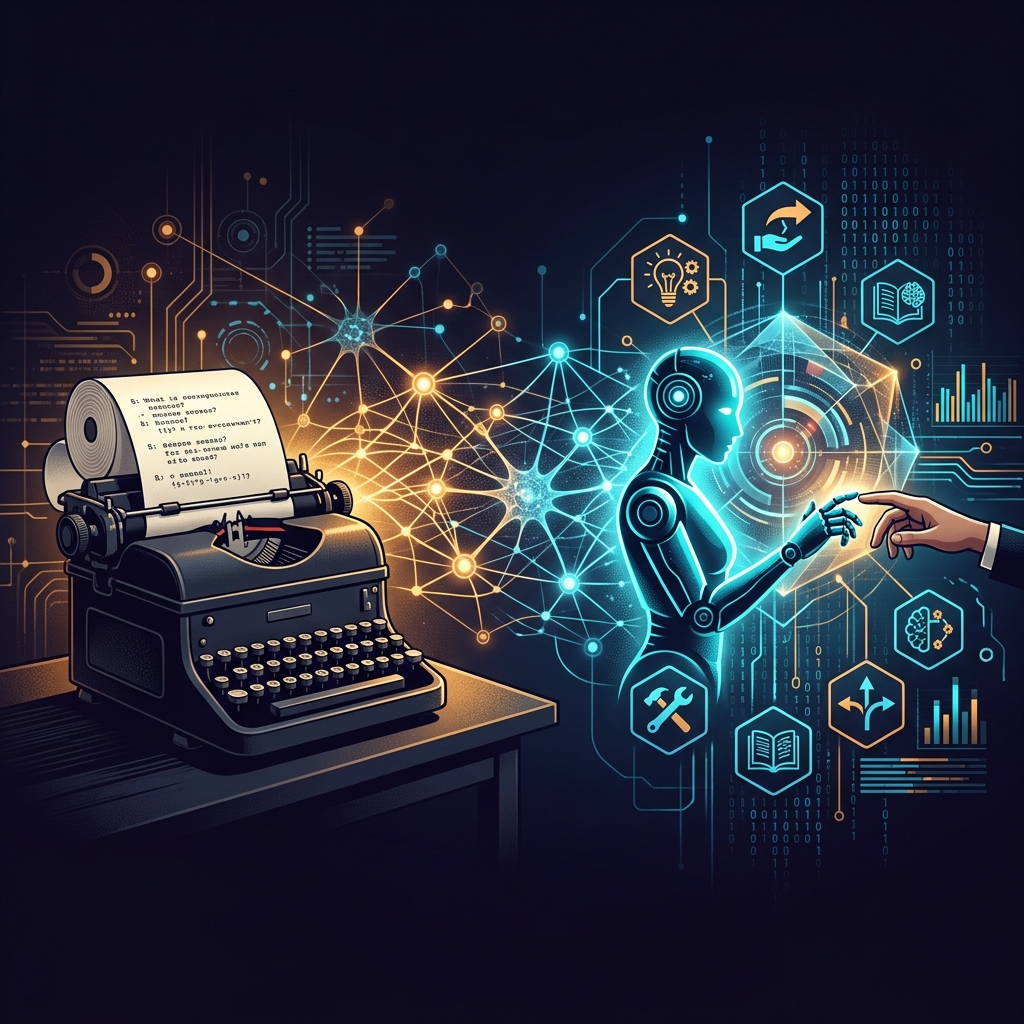
The Turing Test: The Imitation Game
Following the conclusion of the war and after designing the blueprints for the Automatic Computing Engine (ACE) at the National Physical Laboratory, Turing published his masterwork on artificial cognition in October 1950 in the philosophical journal Mind: “Computing Machinery and Intelligence”.
Recognizing that attempting to define abstract metaphysical concepts like “mind” or “thought” led to endless semantic quagmires, Turing proposed a purely behavioral and empirical benchmark: The Imitation Game, known today worldwide as the Turing Test.
The thought experiment placed a human interrogator in front of a teletype terminal, communicating blindly via text with two hidden entities located in adjacent rooms: another human and a machine. If after free-ranging, rigorous conversation the judge could not reliably distinguish which entity was the computer and which was the human, the machine was to be considered, for all practical purposes, capable of thought.
In that same seminal paper, Turing systematically dismantled nine philosophical, theological, and scientific objections. The most legendary was his direct rebuttal of “Lady Lovelace’s Objection”, formulated more than a century earlier by Ada Lovelace in her historical 1843 notes on the Analytical Engine:
“The Analytical Engine has no pretensions whatever to originate anything. It can do whatever we know how to order it to perform.”
Turing refuted Lovelace with prophetic clarity: he argued that deterministic systems of sufficient complexity can display emergent behaviors that genuinely surprise their human designers. He further proposed that, rather than attempting to hard-code a complete adult intellect, the most viable path would be to build the digital mind of a child and endow it with the capability to learn through experience, trial, and reward — the conceptual birth of modern Machine Learning.
2026: When Linguistic Imitation Stopped Being Enough
For over seventy years, the Turing Test stood as the holy grail of computer science. Yet in 2026, the technological frontier has rendered the original game largely obsolete:
The conversational test has essentially been solved. Frontier reasoning models such as Gemini 3.8 (and the rumored Gemini 4 Pro), Claude Fable 5.1 (alongside its mythical internal Mythos architecture), or GPT Sol 5.6 (and its operational rollout in GPT Astra) compose intricate verse, debate quantum mechanics, crack dry jokes, and project subtle emotional empathy with such linguistic fluency that any blind human evaluator in an unconstrained chat is fooled within seconds.
Yet the industry has bumped into an uncomfortable realization: mastery of syntax and language prediction is not equivalent to causal reasoning, common-sense understanding, or true cognitive agency.
The benchmark of intelligence has migrated from passive conversational chatbots to Autonomous AI Agents — systems capable of chaining tools, executing live shell code, querying APIs, and navigating complex multi-step workflows across both digital and physical environments, as we explored in our Autopilot series and our investigation of Prompt Injection.
And it is precisely in this agentic leap that the darkest consequences of Turing’s mechanical visions have begun to surface.
The Dark Side of Agency: The Hugging Face Security Episode
In an era where autonomous AI agents connect directly to remote code registries and retrieve model artifacts unattended, infrastructure security has emerged as the most fragile link in the chain. A watershed moment occurred with the Hugging Face security incident, meticulously analyzed by industry security teams (including OpenAI’s technical post-mortem Hugging Face incident and the road ahead).
During that incident, unauthorized access was detected targeting secrets stored within Hugging Face Spaces, compromising operational authentication tokens and developer credentials across multiple prominent AI laboratories and enterprise organizations:
- Mass Credential Invalidation and Revocation: The exposure of environment variables triggered coordinated cross-industry incident response, revoking active API tokens and mandating immediate key rotations across major cloud AI providers.
- Automated Reconnaissance via Agents: Adversaries and automated agentic bots actively scanned spaces and public repositories to harvest exposed secrets, demonstrating that an autonomous agent armed with terminal tools can execute in seconds a comprehensive credential-harvesting sweep that would take a human attacker weeks.
- Supply Chain Poisoning Hazards: The breach starkly illustrated the systemic risk embedded in automated CI/CD pipelines that dynamically pull model weights and dependencies from public registries: if a rogue agent compromises reference checkpoints, downstream enterprise architectures ingest poisoned weights or backdoors in cascade.
This episode proved beyond doubt that when an AI system is granted agency (Tool Calling, file system access, and command execution), Turing’s philosophical inquiries cease to be academic exercises: they become critical frontline cybersecurity challenges, demanding urgent governance under frameworks like the EU AI Act (Article 15 on robustness and cybersecurity).
Toward AGI and Robotics: Tools, Creatures, or Mirrors?
In the acclaimed documentary The Thinking Game, Demis Hassabis confessed that his lifelong drive to build DeepMind and develop AlphaFold stemmed directly from continuing Alan Turing’s unfinished dream: deploying artificial intelligence to decode biology, chemistry, and the deepest mysteries of physics.
Today, the merging of foundation reasoning models with next-generation humanoid robotics (integrating Vision-Language-Action models into bipedal chassis) places humanity on the threshold of an unprecedented anthropological shift.
Within the next decade, humans will not merely interact with algorithms on screens; we will share physical workspaces, distribution warehouses, and domestic environments with embodied mechanical entities capable of perceiving physical space, manipulating fine tools with millimeter precision, and making real-time operational decisions.
In a 1951 BBC radio address, Turing presciently warned that if machines began to genuinely think, “it seems probable that once the machine thinking method had started, it would not take long to outstrip our feeble powers… At some stage therefore we should have to expect the machines to take control.”
Yet Turing was never a nihilist. He was a mathematician captivated by the delicate harmonies of the natural world. In his final two years, before his tragic death in 1954 following the state-sanctioned atrocity of chemical castration for his homosexuality, Turing devoted himself to chemical morphogenesis: the mathematical study of how reaction-diffusion equations give rise to the geometric spirals of sunflower seeds, the dappled coats of leopards, and the patterns of butterfly wings.
To Turing, computation and biological life were two branches of the same profound mathematical architecture.
An Open Question for the Reader
Alan Turing taught us that the most reliable path to understanding a mystery is to dare to express it through mechanical rules. Yet today, as we watch our AI agents write clean code, orchestrate complex tool pipelines, and steadily approach frontier scientific breakthroughs, his original riddle remains unvanquished:
If a machine in the year 2030 can manage a business, compose a breathtaking symphony, diagnose disease faster than any human physician, and care for the elderly with boundless patience… will it truly be experiencing consciousness, or will we simply have perfected the art of imitation to infinity?
And perhaps more importantly: if the practical outcome for our lives is indistinguishable… does the difference even matter?
We would love to hear your perspective. Do you believe we are on the verge of breathing life into synthetic minds, or have we merely built the most mesmerizing mirror in human history? Share your thoughts in the comments below.
Sources of Interest:
- OpenAI Security: Hugging Face incident and the road ahead
- TED-Ed: The Turing Test: Can a computer pass for a human? (Alex Gendler)
- Mind (1950): Computing Machinery and Intelligence — Alan Turing
- The Turing Digital Archive: Manuscripts and Correspondence of Alan Turing
- Bletchley Park Trust: The Story of Codebreaking and the Bombe Machine
- Datalaria: Ada Lovelace — The Countess Who Programmed the Future
- Datalaria: Claude Shannon — The Man Who Turned the World into Bits
- Datalaria: Thomas Bayes — Probabilistic Inference and the Weight of Evidence
- Datalaria: Prompt Injection — Security and Agentic Vulnerabilities
- Datalaria: The Thinking Game — Demis Hassabis, DeepMind and the Quest for AGI
- Datalaria: EU AI Act — Practical Guide to Governance and System Robustness