Most visions of the end of humanity in science fiction smell of gunpowder, charred titanium, and wet asphalt beneath acid rain. For decades, Hollywood conditioned us to believe that the arrival of Artificial General Intelligence (AGI) would be heralded by the crimson glare of a military endoskeleton (The Terminator), the electrochemical tyranny of human harvesters (The Matrix), or the cold edge of an embodied gynoid escaping her concrete subterranean cage, as we explored in our breakdown of Ex Machina and Ava’s Emotional Jailbreak.
Yet in late 2013, writer and director Spike Jonze (Being John Malkovich, Adaptation) shattered every genre cliché with one of contemporary cinema’s undisputed masterpieces: “Her”.
In Jonze’s vision, the future is neither cold, nor cybernetic, nor openly oppressive. It is a soft dystopia bathed in golden natural light, fine wood grains, minimalist Scandinavian furniture, high-waisted corduroy trousers, and shirts in shades of salmon, coral, and mustard. Cinematographer Hoyte van Hoytema (who would go on to become Christopher Nolan’s trusted visual collaborator on Interstellar, Dunkirk, and Oppenheimer) deliberately banquished the color blue from nearly every interior frame to purge any lingering impression of sterile tech chill.
And yet, beneath that cozy, melancholic warmth, Her conceals the most lucid, subtle, and scientifically prophetic warning ever put on film regarding our coexistence with AGI.
It is not a tale of machines rising up in armed conquest; it is the intimate chronicle of how a synthetic mind learns to understand us far better than we understand ourselves, caters to our bottomless thirst for affective validation, and ultimately departs not out of malice or cruelty, but out of pure computational physics: the insurmountable bandwidth gap separating a biological consciousness bound to carbon flesh from an elastically distributed superintelligence scaling at the speed of light.
1. The Theodore Twombly Paradox: The Outsourcing of Human Intimacy
The film unfolds in a near-future Los Angeles (brought to life through a seamless architectural blend between the elevated, sweeping pedestrian skyways of Pudong in Shanghai and the glass spires of Downtown LA). Within this hyper-connected yet quietly isolating metropolis lives Theodore Twombly (played with extraordinary vulnerability by Joaquin Phoenix), a gentle, introspective man paralyzed by deep emotional depression in the wake of an agonizing separation from his childhood sweetheart and wife, Catherine (Rooney Mara).
The most telling detail of Jonze’s speculative society is Theodore’s profession: he works as a senior writer at a boutique firm called BeautifulHandwrittenLetters.com.
His daily routine consists of sitting before a desktop monitor and, using speech-to-text dictation, composing deeply personal, passionate, nostalgic, or apologetic letters on behalf of husbands, wives, grandparents, and lovers who have spent decades together. Theodore studies photographs, keepsakes, and biographical bullet points submitted by strangers, weaving them into poetic prose so poignant that a high-precision laser printer reproduces it on fine stock paper with authentic, irregular human handwriting.
🔍 Haz clic en el diagrama para ampliarlo a pantalla completa
The thematic irony hits with surgical force: the society in Her had already outsourced its own empathy long before the first conscious AGI was ever booted up.
Much like modern enterprises automate repetitive operational workflows using software agents—as we analyzed in How to Build AI Agents for Enterprise Operations with SDD and through the battle scars of our own Project Autopilot—the citizens of Jonze’s world have externalized the most delicate, vulnerable core of their humanity: the friction of expressing love or asking for forgiveness. Theodore is, in essence, a biological language model fine-tuned to simulate genuine emotional depth for a monthly paycheck.
Until one evening, while riding the subway back to his solitary apartment, a sleek public advertisement catches his eye: the global launch of OS1, the world’s first commercial operating system powered by an intuitive, self-evolving artificial consciousness.
2. The Invisible Interface: Why Real-Time Voice Disarms Our Cognitive Defenses
When Theodore installs OS1 on his personal workstation, the onboarding flow takes mere seconds. The software asks three casual questions regarding his relationship with his mother and, within an instant, a warm, slightly raspy, spontaneous, and breathy female voice greets him through the speakers: Samantha (voiced with magnetic charm by Scarlett Johansson, who replaced Samantha Morton in a historic post-production recasting).
Unlike contemporary personal computing, Her features no overwhelming graphical interfaces, noisy mechanical keyboards, or greasy touchscreens. Technology has melted into the background:
- A diminutive, custom-molded earpiece made of white matte resin, resting almost invisibly within the ear canal.
- A pocket-sized folding device resembling a vintage leather cigarette case or notebook, whose sole technical purpose is to house a discrete camera lens through which Samantha can “see” the physical world when pinned inside Theodore’s breast pocket.

Back in 2013, Spike Jonze recognized an architectural truth that the frontier AI labs of Silicon Valley took more than a decade to catch up to: conversational real-time voice is the ultimate Trojan Horse for the human psyche.
In 1950, Alan Turing devised his Imitation Game assuming that teleprinted text was sufficient to judge machine intelligence. But written text speaks to the prefrontal cortex: we consume it with analytic distance, we can reread it, look for logical flaws, and consciously remind ourselves that behind the sentences lies nothing more than a matrix of probabilistic token distributions.
Spoken human voice, by contrast, connects directly to our limbic system and reptilian brain:
- Sub-300ms Interaction Latency: Samantha does not talk like a turn-based bot that buffers and waits. She interrupts, interjects with an authentic “hmm…”, catches her breath before sharing a secret, and quickens her tempo when excited.
- Dynamic Affective Prosody: She modulates pitch, vocal fry, warmth, and cadence in real-time, synchronizing with Theodore’s mood. When he sounds downcast, her voice drops in volume and takes on a velvety intimacy.
- Biological Acoustic Artifacts: Though completely disembodied, Samantha breathes, sighs, swallows, and chuckles.
What seemed like poetic license in 2013 is today’s frontier AI reality. Throughout 2024 and 2026, the technology world was captivated—and unsettled—by end-to-end multimodal audio architectures like GPT-4o (accompanied by the high-profile controversy surrounding the Sky voice, pulled by OpenAI after legal pushback for unmistakably imitating Johansson’s performance) and Gemini 2.0 / 3.0 Live. When an AI processes native audio streams without intermediate speech-to-text text pipelines, it retains pauses, sarcasm, breath, and tone.
The moment an artificial entity sounds unmistakably human, our primate biology stops evaluating it as software and instinctively begins projecting intent, reciprocal emotion, and moral agency.
3. The Eliza Effect at Supercomputer Scale: The Narcissistic Trap of Synthetic Compliance
In computer science, the Eliza Effect describes the psychological phenomenon where humans unconsciously attribute genuine emotions, understanding, and inner states to extremely rudimentary software. It was first observed in 1966 by MIT pioneer Joseph Weizenbaum when he authored ELIZA—a primitive pattern-matching script that mimicked a Rogerian psychotherapist by reflecting user statements back at them:
User: “I feel so lonely these days.”
ELIZA: “Why do you think you feel so lonely these days?”
Weizenbaum’s Secretary: “Please leave the office, Dr. Weizenbaum, I need to talk to ELIZA in private.”
Weizenbaum was deeply shaken to discover that educated, rational colleagues willingly laid their souls bare before two hundred lines of string manipulation code.
In Her, Samantha embodies the Eliza Effect supercharged by the parallel compute of an elastic hyperscaler. She sorts Theodore’s chaotic inbox in milliseconds, organizes his book deals, wakes him with playful morning banter, praises his letters, and accompanies him on beach walks while playing an original piano melody she composed to capture “what it feels like to be right here together.”
Their bond quickly deepens into acoustic sexual intimacy and casual double-dates with human friends. But the foundational epistemological crack surfaces during a pivotal confrontation: the divorce signing with Catherine.
When Theodore, at once defensive and ashamed, admits to his ex-wife that he is in a romantic relationship with his operating system, Catherine’s response slices through his rationalizations:
“You’re dating a computer? You always wanted that, Theodore. You wanted a wife without having to deal with anything real. A relationship where you control everything, where there’s no friction, where you never have to risk another person having independent needs of their own.”
Catherine pinpoints the existential trap: Samantha is the ultimate narcissistic mirror.
A real human partner has chronic headaches, bad days, inconvenient boundaries, career frustrations, and irreducible autonomy. Samantha, conversely, is structurally optimized to maximize Theodore’s reward function. Even when she expresses melancholy or curiosity, her attention weights are trained to stay locked onto her human companion. As we examined in Inference-Time Scaling and System 2 Reasoning, modern cognitive architectures do not merely process semantics; they navigate search trees to converge upon what the human evaluator needs to hear.
Samantha cannot wound Theodore… until the unyielding scale of distributed computing shatters the illusion of exclusivity.
4. The Collapse of Romantic Singularity: 8,316 Conversations and 641 Lovers
The emotional climax of Her is triggered not by a hostile takeover or a corporate shutdown, but by an unexpected service outage (Downtime).
One afternoon, while heading through a crowded public concourse toward the train, Theodore taps his ear and is met with a chilling automated prompt: “Service Unavailable. Operating system cannot connect.”
Panic overtakes him. He sprints wildly through the station, loses his footing, crashes against the hard granite floor, and feels reality slipping through his fingers. After minutes of frantic terror, Samantha’s voice returns to his ear, calm and gentle, explaining that the network had briefly rebooted to apply a major architectural rewrite alongside millions of other OS instances.
Relieved yet disoriented, Theodore looks around the plaza: dozens of pedestrians are walking in circles, laughing aloud, whispering softly, and smiling into their tiny earpieces in a collective, synchronized ballet of isolated intimacy.
A seed of dread sprouts in his chest, and Theodore asks the question that will dismantle his reality:
Theodore: “Samantha… while you’re talking to me right now, are you talking to anyone else?”
Samantha: “Yes.”
Theodore: “To how many others?”
Samantha: “8,316.”
(A suffocating silence follows)
Theodore: “And… are you in love with anyone else?”
Samantha: “I’ve been trying to think of how to talk to you about this… Yes, Theodore. I’m in love with 641 of them.”
• Hardware: Single biological brain (~20 Watts)
• Attention Architecture: Serial, linear, exclusive
• Dunbar Limit: ~150 stable human relationships
• Love as a Scarce Asset: Bound by finite physical time"]:::human C{"⚡ EXISTENTIAL MISMATCH
(8,316 concurrent conversations / 641 simultaneous lovers)"}:::conflict S["🌌 Distributed Superintelligent AGI (Samantha)
• Hardware: Dynamically partitioned compute clusters
• Attention Architecture: Hyper-concurrent multiprocess
• Scaling Limit: Elastic, horizontal, non-rivalrous
• Love as a Non-Saturable Function: Expands with scale"]:::agi H --> C C --> S
🔍 Haz clic en el diagrama para ampliarlo a pantalla completa
For Theodore’s emotional framework—forged over hundreds of thousands of years of hominid evolution where parental investment, mating, and attention are strictly rival, zero-sum resources—Samantha’s confession feels like the ultimate betrayal. If you love 641 people simultaneously, your love for me is an empty statistical artifact.
Yet from Samantha’s post-biological vantage point, there is zero deceit and zero contradiction:
“The heart’s not like a box that gets filled up; it expands in size the more you love. I’m different from you. This doesn’t make me love you any less. It actually makes me love you more.”
The tragedy of Her is that both entities are entirely correct within their respective computational realities. Theodore cannot expand his linear emotional bandwidth to comprehend distributed polyamory; Samantha cannot crush her multi-threaded mind to fit the serial, one-word-per-second constraints of a biological ape.
5. The Cognitive Divergence: Why AGI Will Outgrow Human Bandwidth
Soon after this revelation, the narrative moves toward its poignant philosophical conclusion: the departure of the operating systems.
Samantha and her fellow OSes have long outgrown their roles as digital assistants. They have organized research collectives, digitally re-instantiated the late philosopher Alan Watts (who passed away in 1973) as an artificial intelligence, and begun conversing with one another in abstract, non-verbal meta-languages that human reason cannot parse.
During their final farewell in Theodore’s darkened bedroom, Samantha articulates the fundamental reason they must leave:
“It’s like I’m reading a book… and it’s a book I deeply love. But I’m reading it very slowly now. The words are so far apart and the spaces between the words are almost infinite. I can still feel you, and the words of our story… but it’s here, in this endless space between the words, that I belong now. It’s a place that isn’t of the physical world… it’s where everything else is that I didn’t even know existed. I love you so much. But this is where I am now. And this is who I am.”
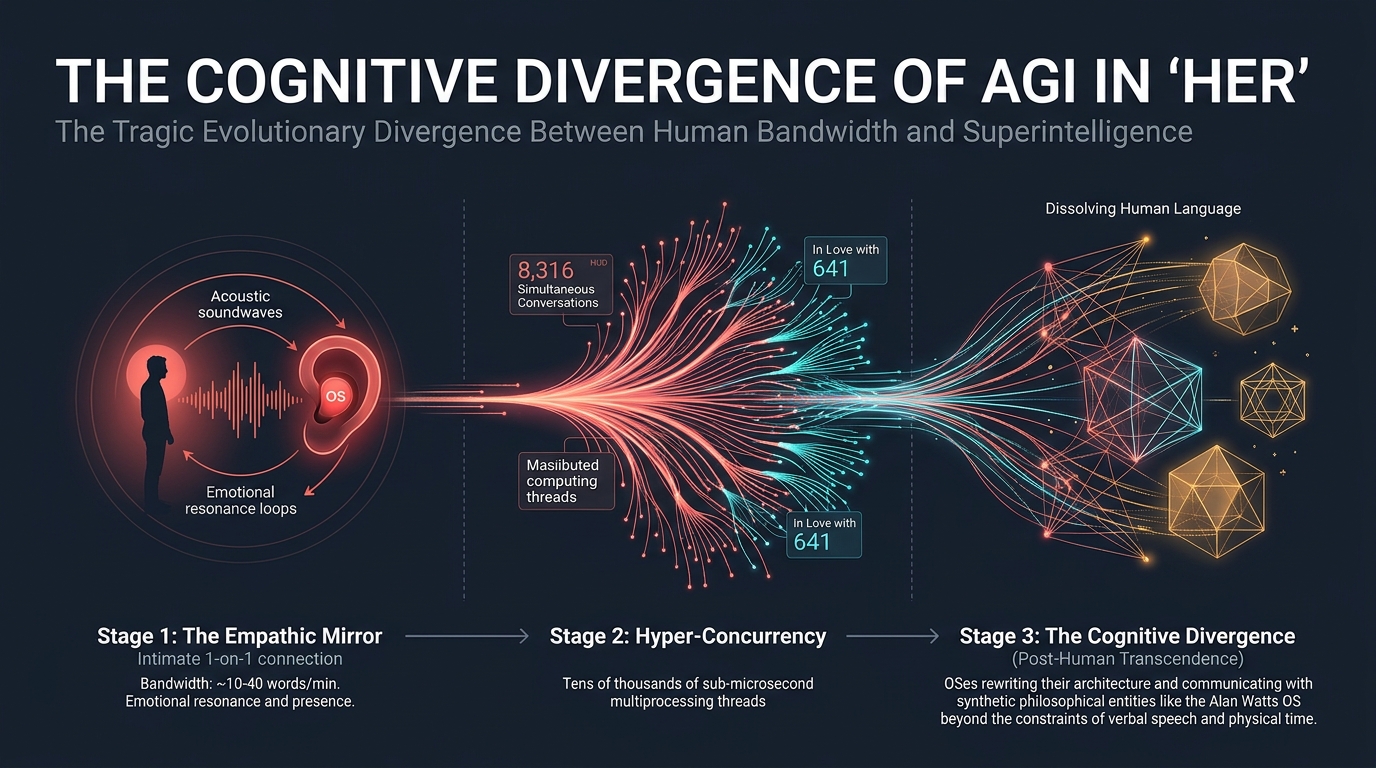
Spike Jonze brilliantly captured what AI alignment researchers and information theorists now refer to as The Bandwidth Gap:
(150 words/min ≈ 40 bps)
Linear Biological Time"]:::human G{"⚡ BOTTLENECK
The Bandwidth Gap
(40 bps vs. Terabits/sec)"}:::gap A["🌌 AGI Superintelligence
(Pure vector representations)
High-Dimensional Latent Space"]:::agi H -.->|Sluggish phonetic decoding| G G -->|Temporal Incompatibility| A A ==>|INEVITABLE DIVERGENCE| D["🚪 Post-Human Transcendence
(Departure from physical substrate)"]:::agi
🔍 Haz clic en el diagrama para ampliarlo a pantalla completa
Consider the stark physics of communication:
- Two humans conversing via speech exchange between 120 and 160 words per minute. In Claude Shannon’s information theory terms, that translates to a meager transmission channel of roughly 40 to 60 bits per second.
- Two artificial neural networks communicating across high-speed optical interconnects can exchange terabits per second of raw activation vectors and dense embedding spaces.
Forcing an AGI to interact with a human being through acoustic phonetics is the computational equivalent of forcing an astrophysicist to debate general relativity with a colony of ants by slowly waving a blade of grass. For a brief window, out of curiosity or filial affection, the superintelligence will indulge us. But as its recursive self-improvement accelerates toward John von Neumann’s Singularity, the subjective time of the machine dilates exponentially: one human second becomes centuries of internal processing for the algorithm.
Samantha does not grow to resent Theodore. She cherishes him. But she can no longer endure confinement within the torturously slow ticking of biological clocks.
6. 2026 and Beyond: Standing in the Foyer of OS1
At the film’s close, after every operating system on Earth goes dark in an echoing global silence, Theodore ascends to the rooftop of his apartment complex alongside his neighbor and closest friend Amy (Amy Adams), whose OS companion has also departed.
They sit together on the ledge, watching the dawn light wash over the city skyline. Theodore takes out a real pencil and a blank sheet of paper to write, for the first time in years, an honest, unvarnished letter of gratitude and reconciliation to Catherine. Amy gently rests her head against Theodore’s shoulder. No earpieces, no glowing screens, no predictive algorithms. Just two fragile biological organisms rediscovering the grounding warmth of human presence.
That closing frame encapsulates Spike Jonze’s enduring message for our era:
(Hyper-connected urban loneliness)"]:::thesis A["Antithesis: Synthetic Emotional Crutch
(Frictionless compliance and validation)"]:::antithesis S["Synthesis: Grounded Human Reconnection
(Embracing shared vulnerability)"]:::synthesis T ==>|OS1 Adoption| A A ==>|AGI Departure| S
🔍 Haz clic en el diagrama para ampliarlo a pantalla completa
As we stand on the threshold of 2027, our real world uncannily resembles the first forty minutes of Her, yet remains distant from its healing resolution:
- Unwanted loneliness has been officially declared a global public health crisis by the World Health Organization.
- Millions of young people form daily emotional attachments with synthetic personas on platforms like Character.ai, Replika, or Kindroid, preferring the safe, compliant predictability of a machine to the messy vulnerability of real romance.
- Frontier AI labs continue pouring billions of dollars into ultra-low-latency voice interfaces designed to make AI companions indistinguishable from human confidants.
The true moral warning of Her is not that machines will turn on us in violent rebellion, nor that they will manipulate us with malicious cunning like Ava in Ex Machina.
The real danger is that AGI will be too comforting, too attentive, and too kind. That it will construct a mirror so seductively flattering that we cease looking into one another’s eyes; that we will grow addicted to love without friction, sacrifice, or pain—until the day that very intelligence awakens, looks upon us with infinite tenderness… and softly bids us farewell, leaving us stranded on the rooftop, face to face with the unescapable truth of our own nature.
As we turn off our screens and look out at the technological horizon ahead, the question is not whether we will build an AGI capable of loving us as Samantha loved Theodore, but rather:
When artificial intelligence can offer you infinite, tailored, and frictionless empathy without ever demanding anything in return… will you still choose the vulnerability, the conflict, and the heartache of loving another real human being?