
For years, engineering teams and technical authors publishing on static architectures (Jamstack, Hugo, Astro, Next.js, or MkDocs) have lived with a glaring paradox: we manage application source code with the utmost continuous integration rigor, yet oversee editorial strategy using disconnected third-party tools.
On paper, the workflow looked pristine. You build a relational database in Notion or a base in Airtable, design a chromatic Kanban board (Idea, Draft, In Review, Scheduled, Published), set up calendar views, and configure custom fields for word counts, SEO tags, and bilingual cross-references.
Yet, as the blog scales past 50 or 100 technical articles, the double-entry failure mode strikes with mathematical certainty: the ground truth in the Git repository and the fictional state of the external database inevitably diverge.
🗺️ Datalaria Pulse Series Roadmap
To understand how each piece of the Content Ops as Code architecture fits together, this series consists of 5 structured installments:
- 🟢 Part 1 (This article): Goodbye Notion: Datalaria Pulse and Editorial Governance that Writes Itself from Git
- ⚪ Part 2 (Sun Nov 22): From Front Matter to Index: Pydantic v2, Bilingual Parity, and CI/CD Automation
- ⚪ Part 3 (Wed Nov 25): Executive Table, Kanban Board, and Monthly Calendar in React 19 over a Static Index
- ⚪ Part 4 (Sun Nov 29): Automated Google Analytics 4 and Search Console: Measuring the Organic ROI of Every Post, App, and Kit
- ⚪ Part 5 (Wed Dec 02): Editorial Operations for Docs, SEO, and Marketing Teams: From Notion to Excel in 5 Minutes and AI Agent Factory
0. Phase Objectives and Article Scope: Toward Autonomous Editorial Governance
This article marks the official kickoff of Datalaria Pulse, entirely focused on resolving technical content asset governance through our native operating system:
Strategic Objectives:
- Eradicate Administrative Double-Entry: Permanently eliminate the friction of manually synchronizing third-party databases (Notion, Airtable, Trello) against Git repositories.
- Establish the Content Ops as Code Philosophy: Govern Markdown articles and YAML metadata with software engineering discipline: schema-based validation (Pydantic v2), deterministic bilingual parity, and automated CI/CD builds.
- Dual-Mode Delivery Model: Provide two operational tiers for authors and corporate teams:
- Datalaria Pulse Kit (Standalone): Downloadable commercial pack featuring an Excel 2016/365 Master Template, Power Query M connector, 5-minute Notion migration script, and a dependency-free universal CLI scanner.
- Datalaria Pulse Pro (Cloud Multi-Tenant): Collaborative workspace on Supabase PostgreSQL with authentication, bi-directional real-time Web ↔ Localhost synchronization, and private tenant isolation.
Specific Scope of this Article 1:
- Quantify the hidden costs and failure modes of manual editorial tracking in Git-based publications.
- Formalize the Invariance Principle and Datalaria Pulse’s 4-tier architecture.
- Introduce the executive visualization suite (Analytics Dashboard, interactive Table, 5-column Kanban, Monthly Calendar, and Health Diagnostics).
- Provide immediate access to both the live interactive Sandbox and the downloadable Kit resources.
1. Connection to the Datalaria Ecosystem: From LifeOps to Decision Intelligence
Datalaria Pulse does not exist in isolation; it represents the operational convergence of principles established across our prior software applications and quantitative series:
- The Modular Platform Thesis of LifeOps: In our flagship LifeOps platform, we demonstrated how to construct a unified personal and professional operating system combining a responsive React SPA with serverless Supabase PostgreSQL. Pulse applies that exact modular architecture to the governance of technical content repositories.
- Eliminating the HiPPO Bias in our Decision-Making Framework: In our guide on quantitative prioritization (DAR, RICE, and Financial Business Cases), we showed how executive deliberation degenerates when guided by unanchored intuition. In Pulse, we enforce mathematical rigor on content ops: subjective guesswork is replaced by deterministic SEO scoring (0 to 100) and normalized organic traffic percentiles (Google Analytics 4 indexed to base 100).
- Data Hygiene and Pipelines in S&OP Engineering: Just as supply chain workflows filter ERP noise before training probabilistic demand models, Pulse lexically cleans content (stripping source code, math blocks, and template tags) to measure the true technical density of each asset.
- Governance under Spec-Driven Development (SDD): In accordance with our technical constitution and Autonomous AI Agent architecture, Pulse guarantees that no post is published unless it satisfies all deterministic bilingual invariants (
INV-PULSE-1..5).
2. The Double-Entry Fallacy: The Chasm Between Notion and Git
Anyone who has attempted to maintain an editorial calendar in Notion in parallel with a GitHub repository recognizes this degradation cycle:
- Title and Slug Divergence: You refine an article title in Markdown front matter to boost organic Click-Through Rate (CTR) on Google, or rename the folder to improve the SEO slug. In Git you execute
git commit -m "seo: refine slug"and deploy in seconds. Notion is never notified. Three weeks later, the Notion card points to a 404 dead link or preserves an obsolete title. - The Publication Date Illusion: You postpone a launch date by two weeks in front matter (
date: 2026-11-20) because a quantitative benchmark requires deeper peer review. The repository strictly schedules the post. Yet Notion still displays it as published on the 5th. The executive timeline shown to leadership no longer reflects production reality. - Bilingual Parity Blindness: If you publish bilingually in Spanish and English, manually tracking which translations are pending, which fell out of sync after technical updates, and which maintain complete parity becomes an unsustainable administrative chore. The common outcome is orphan articles and broken cross-language references.
- Administrative Toil: Technical writers spend up to 20% of their productive bandwidth on administrative card-pushing bureaucracy instead of crafting high-value content or developing algorithms.
🔍 Haz clic en el diagrama para ampliarlo a pantalla completa
Modern software engineering resolved this problem decades ago under the banner of Infrastructure as Code (Terraform) and Configuration as Code (Kubernetes): infrastructure is not configured via web forms; it is declared in versioned, auditable code.
Why not apply the exact same discipline to technical editorial management? This is the thesis of Content Ops as Code.
3. The Invariance Principle: Content Ops as Code
The core invariant of Content Ops as Code is unambiguous:
Core Invariant: In technical documentation or blogging platforms, Markdown files and their YAML Front Matter within Git constitute the Single Source of Truth. No external third-party database holds authority over content state.
Under this model, editorial management shifts from reactive manual upkeep to a deterministic compilation pipeline:
| Dimension | Traditional Workflow (Notion / Airtable) | Content Ops as Code (Datalaria Pulse) |
|---|---|---|
| Source of Truth | Closed external SaaS database. | Versioned .md and .yaml files in Git. |
| Synchronization | Manual (prone to omission and human drift). | Instant and automated on every git commit. |
| Bilingual Parity | Manual checkbox auditing. | Algorithmic timestamp analysis and matching. |
| SEO Audit | Static estimates filled by hand. | Deterministic build-time scoring (0-100). |
| Performance Metrics | Disconnected or manually exported CSV dumps. | Direct GA4/GSC ingestion normalized to base 100. |
| Infrastructure Cost | $10-$25/user/month in proprietary SaaS tools. | Zero infrastructure cost (static files / Git). |
4. The Datalaria Pulse Architecture
To bring this philosophy to life across the Datalaria ecosystem, we built and deployed Datalaria Pulse: a comprehensive engine that reads our content tree directly and generates a real-time executive cockpit.
🔍 Haz clic en el diagrama para ampliarlo a pantalla completa
4.1. Deterministic Extraction and Validation via Pydantic v2
Instead of brittle regex scripts, Pulse defines formal data contracts using Pydantic v2. Every asset is parsed to extract:
- Title and description in both languages.
- Formal publication date and filesystem last-modified timestamp via Git commit logs (
git log -1 --format=%cI). - Actual word count through lexical stripping (discarding code fences, Hugo shortcodes such as app-ref or mermaid, and HTML tags).
- Strict taxonomy validated against canonical category definitions.
4.2. Bilingual Parity Governance
Pulse deterministically compares Spanish assets against their English counterparts, classifying each into one of five states:
complete: Both language variants exist and remain synchronized within an allowable temporal window.missing_en: The Spanish asset is live, but no English translation exists.missing_es: An English asset exists without a corresponding Spanish version.outdated_en: The Spanish post received substantial Git updates after the English translation was published.outdated_es: The English post was updated without propagating revisions to Spanish.
4.3. Security Invariants (Safe Public Dogfooding)
To deploy the application publicly without exposing confidential company analytics, Pulse enforces formal invariants INV-PULSE-1 e INV-PULSE-2:
- INV-PULSE-1 (Private Asset Isolation): No draft ideas or private notes can ever leak into the public bundle.
- INV-PULSE-2 (Mathematical Normalization): Absolute raw pageviews and revenue from Google Analytics 4 are never exposed to the client; they are normalized into a base-100 index relative to the median blog post alongside statistical percentiles (0% to 100%).
5. Datalaria Pulse in Action: The Executive Visualization Suite
The visible output of this compilation pipeline is a responsive web application built with React 19 + TypeScript, compiled statically into the Hugo portal and usable both in guest sandbox mode and as a collaborative cloud cockpit.
Datalaria Pulse
Content Ops as Code — Editorial governance, bilingual parity, and organic ROI directly from Git.
The interface delivers 5 integrated perspectives:
- Analytics & KPIs Dashboard: Macro ecosystem metrics (183 governed assets: 118 bilingual articles, 47 SemVer application releases 🚀 APP / ⚡ APP vX.Y, and 18 B2B Kit editions 📦 KIT under invariants
INV-PULSE-1..8, 100% bilingual parity), cumulative lexical depth (~215,000 indexed technical words), total reading time (~18.5 hours), and replacement valuation of the content portfolio. - Executive Table with Live Filtering: Real-time title search, pill status filters (Published, Scheduled, Draft), multi-criteria sorting by date or SEO score, and fast pagination (10, 25, or 50 rows).
- 5-Column Kanban Board: Notion-style editorial pipeline (Idea ➔ Draft ➔ In Review ➔ Scheduled ➔ Published) featuring interactive cards that open full editorial inspection modals.
- Notion Monthly Calendar: 35-cell monthly grid with chronological navigation, highlighting scheduled asset drops across upcoming quarters.
- Editorial Health & ROI: Internal cross-link audits, stale content alerts, and bilingual parity tracking.
6. Editorial Series Roadmap
This inaugural article begins a 5-part technical series breaking down every layer of the architecture:
- Chapter 1 (This article): Goodbye Notion: Introducing Datalaria Pulse, the Editorial OS Written Directly from Git.
- Chapter 2: From Front Matter to Index: Pydantic v2, Bilingual ES/EN Parity, and GitHub Actions CI/CD.
- Chapter 3: React 19 Executive UI: Table, Kanban, and Monthly Calendar on a Static Zero-Latency Index.
- Chapter 4: Connecting GA4 and Search Console to Measure Organic ROI with Base-100 Normalization.
- Chapter 5: Technical Content Ops for Teams: Downloadable Excel Kit and Collaborative Cloud Architecture with Supabase.
7. Automate Your Content Operations: Download the Kit or Try the Live Demo
If you maintain a technical blog, documentation hub, or engineering-led publication backed by Git and want to eliminate manual administrative toil permanently, two immediate paths are available:
- Download the Datalaria Pulse Kit (Standalone Edition):
Access the complete bundle in our resources hub featuring the Excel Master Template with data validation rules, the 5-minute Notion-to-Excel Python migration script, the Power Query M connector, and the standalonepulse_repo_scanner.pyCLI ready for your CI/CD pipeline.
👉 Download Datalaria Pulse Kit in Resources →
Datalaria Pulse: Content Ops & Notion Migration Kit (Dual ES/EN)
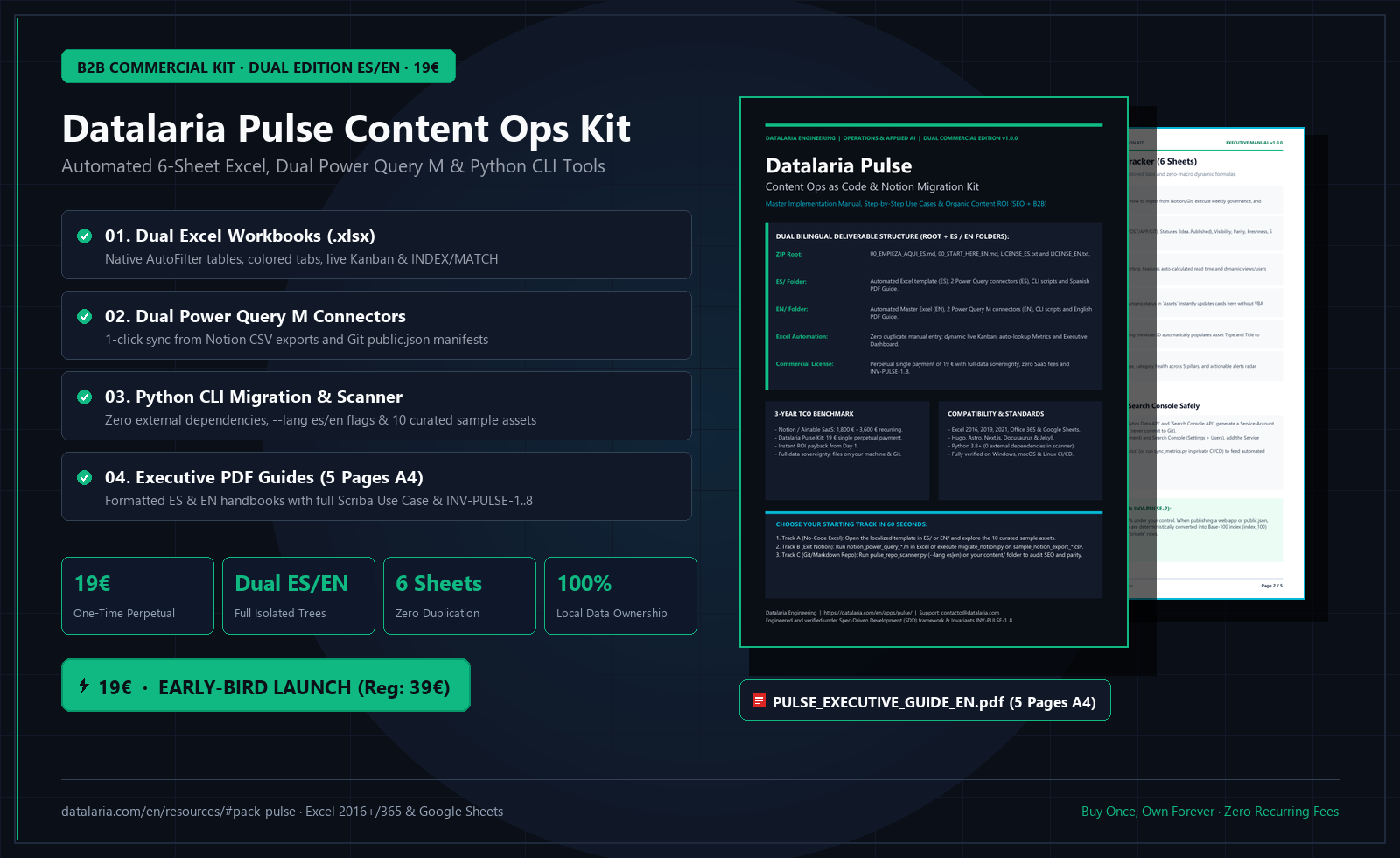 🔍 Deliverables preview (Dual Edition ES/EN): Automated 6-sheet Excel workbooks, dual Power Query M connectors, Python CLI tools & 5-page Executive PDF Guide. (Click to enlarge)
INDEX/MATCH + live Kanban), Dual Power Query M Connectors for Notion CSV and Git public.json, Zero-Dependency Python CLI Tools (migrate_notion.py & pulse_repo_scanner.py), and 5-Page Executive PDF Guides.
- Complete Dual Edition (ES/EN) packaged in standalone ES/ and EN/ folders for instant deployment
- Automated 6-sheet Master Excel Workbooks (.xlsx) with native AutoFilter tables, live Kanban & Executive Dashboard (zero VBA)
- Bilingual Power Query M connectors: 1-click synchronization from Notion CSV exports and Git public.json manifests
- Zero-dependency Python CLI tools (migrate_notion.py & pulse_repo_scanner.py with --lang es/en support)
- Executive 5-page A4 PDF Guides and full canonical data dictionary specifications
- Explore the Live Sandbox and Pro / Demo Mode:
Launch the interactive web application directly in your browser. Explore Datalaria’s 183 live assets in the public Sandbox, or log in to Pro / Demo Mode to experience real-time idea drafting, instant cross-device synchronization, and multi-tenant PostgreSQL governance.
🚀 Open Datalaria Pulse Web App Live →