Do you remember your first day at your last job? The excitement probably quickly mixed with a mountain of forms, many documents in different inaccessible paths, outdated or incomplete manuals, work tools not available… or even lack of equipment and desk space in the office?
If this sounds familiar, you are not alone. I am not an HR expert, but I have had to deal with avoiding all these problems with the onboarding of new talent, faced with a process that is currently painful, expensive, and, frankly, inefficient.
The traditional onboarding process is broken. But there is a new frontier where Generative Artificial Intelligence (GenAI) and Intelligent Document Processing (IDP) are not only streamlining paperwork but are redefining the human experience of joining a company.
Based on a recent analysis of document and information management in onboarding, we explore how to transform “infoxication” into effective integration.
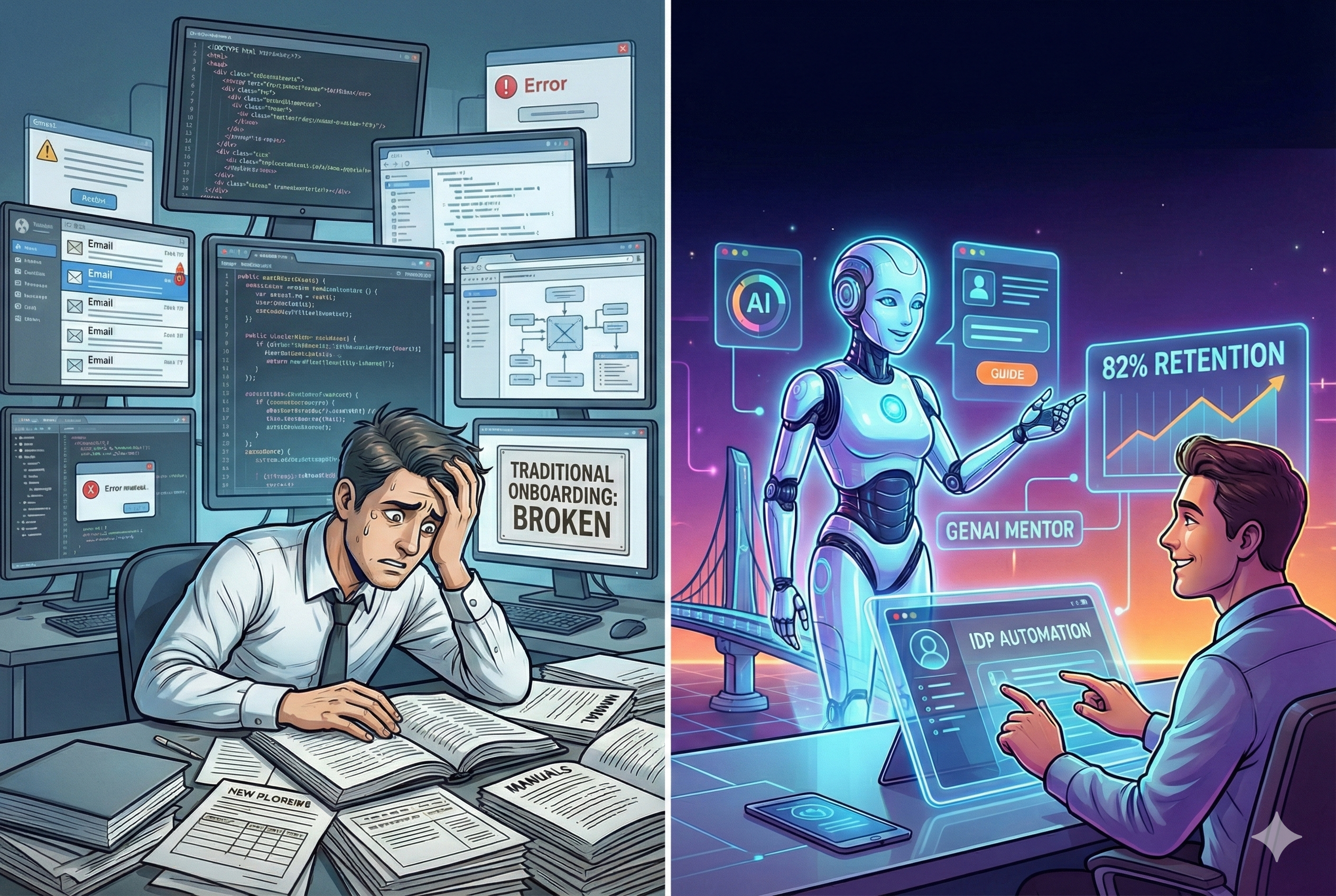
The Harsh Reality of Traditional Onboarding: Numbers That Hurt
The current landscape regarding the incorporation of new talent is worrying in large tech companies. Despite the massive investment in recruitment, the critical “landing” phase remains a costly bottleneck, apart from also dampening the spark of motivation and limiting the potential of new workers.
The data is overwhelming:
- The cost of time: The average time to complete an onboarding process is 24 days. That’s almost a month of reduced productivity.
- The financial cost: The average cost per new hire hovers around $4,000.
- The wrong focus: 58% of organizations admit that their onboarding focuses mainly on paperwork and processes, rather than on culture or development.
- The disconnect: Perhaps the most alarming figure is that only 12% of employees believe their company does a good job with onboarding.
The consequence of this poor management is clear: 31% of workers have quit a job within the first six months. We are losing talent almost as fast as we hire it.
The Problem: “Drinking from a Firehose”
There are two critical pain points that saturate the new employee:
- The Document Burden (Bureaucracy): These are repetitive, manual processes prone to human error that consume HR team time.
- Information Overload (“Infoxication”): The new employee receives company policies, regulations, tool guides, and corporate culture all at once. It is impossible to retain so much information at once.
The result is an overwhelmed employee who spends their first few weeks navigating bureaucracy instead of adding value.
The Solution: A 24/7 Mentor Powered by AI
The revolution in onboarding is not limited to digitizing existing documents; it is about fundamentally redefining how new employees interact with the company from the very first moment. The key proposal is to implement AI as a “copilot” or virtual mentor, a constant guide that accompanies the employee from day zero, facilitating their integration and accelerating their productivity.
This transformation is achieved through the strategic combination of two powerful technologies:
- IDP (Intelligent Document Processing): Capable of extracting, understanding, and processing information from structured and semi-structured documents.
- GenAI (Generative Artificial Intelligence): Uses Large Language Models (LLMs) to understand natural language, context, and generate human-like responses.
This technological duo addresses the two main challenges of traditional onboarding:
1. Automation of Bureaucracy (Document Management)
The traditional process of collection and verification of documentation, equipment requests, access, and permissions is usually a bottleneck that involves multiple actors (the employee themselves, their manager, HR, IT, etc.), consuming valuable time and generating friction.
AI transforms this manual and tedious process into an agile and automated workflow:
- Automatic Extraction and Validation of Data: The employee’s documents (ID, passport, degrees, etc.) are uploaded to a secure platform. The IDP automatically extracts the relevant data, verifies its authenticity, and compares it with existing information, flagging any discrepancies for review.
- Tools: Platforms like DocuSign CLM, Abbyy FlexiCapture, or Kofax use IDP to streamline document management.
- Automatic Generation of Forms and Contracts: Based on the extracted information and position data, AI can automatically fill out tax forms, employment contracts, confidentiality agreements, and other legal documents, ready for digital signature.
- Orchestration of Requests (IT, Facilities, etc.): AI can automatically initiate workflows to request necessary computer equipment, create user accounts, assign access permissions to specific systems, request building access cards, etc., all based on the position profile.
- Example: A new software developer, upon being hired, automatically triggers the request for a laptop with specific specifications, access to the code repository, development tools, and team communication platforms, without manual intervention from their manager or HR.
- Tools: Workflow automation platforms like ServiceNow, Jira Service Management, or Zapier can integrate with AI to orchestrate these tasks.
The result is that a process that traditionally could take weeks (“24 days”) is reduced to a matter of hours, allowing the new employee to be operational and focused on their work from day one.
2. The End of “Infoxication” (Information Management)
Information overload is a common problem in onboarding. New employees are inundated with extensive manuals, outdated guides, and complex procedures that they can hardly absorb and retain.
Generative AI offers an elegant and effective solution through the creation of a Virtual Onboarding Assistant based on RAG (Retrieval-Augmented Generation). This assistant acts as an always-available mentor, capable of answering questions and providing relevant information at the moment it is needed:
- Dynamic and Centralized Knowledge Base: The company uploads all its internal documentation (policies, procedures, guides, wikis, etc.) into a vector model, creating a unified and easily accessible knowledge base.
- Natural Language Queries (Conversational): The employee can interact with the assistant as if they were talking to an experienced colleague.
- Examples of queries:
- “Who should I talk to to request access to the data analysis tool?” -> The assistant identifies the person responsible for the tool and provides their contact details or initiates the request process.
- “How do I request my vacation days and how much notice is required?” -> The assistant explains the procedure, links to the corresponding tool, and mentions the notice policy.
- “Where can I find the style guide for report writing?” -> The assistant provides the direct link to the document or a summary of the key points.
- Examples of queries:
- Precise and Contextualized Responses: The assistant not only searches for keywords but understands the intent of the question and provides precise responses extracted from internal documentation, always citing the source for greater transparency and trust.
- Summaries and Personalization of Learning: AI can generate executive summaries of long and complex documents, facilitating their understanding. In addition, it can adapt information and training resources to the specific role of the employee, ensuring that they only receive information relevant to their position and level.
- Example: A new manager will receive detailed information on performance evaluation processes and team management, while a technical specialist will focus on the specific tools and procedures of their area.
- Tools and Platforms:
- Virtual Assistants: Platforms like Microsoft Copilot (integrated into M365), Notion AI, Glean, or custom developments with OpenAI API or Google Cloud Vertex AI can function as this virtual mentor.
- Employee Experience Platforms (EXP): Tools like Microsoft Viva or Workday Peakon Employee Voice integrate AI capabilities to personalize the onboarding experience and offer relevant resources.
In summary, the AI-powered virtual mentor transforms onboarding from an overwhelming and bureaucratic experience into an agile, personalized, and employee-centric process, allowing them to acquire the knowledge and tools necessary to succeed from day one.
Conclusion: The 82% Retention Opportunity
Technology does not seek to dehumanize onboarding, quite the contrary: it seeks to free humans (both the new employee and HR staff) from robotic tasks so they can focus on human connections, culture, and strategic objectives.
The prize for doing it right is enormous. According to the studies cited in the report, a great onboarding experience can improve retention of new employees by a staggering 82%.
In a competitive talent market, leaving the integration process in the hands of static PDFs and email chains is no longer a viable option. It’s time for AI to take on the heavy lifting of “day one”.
Key References Mentioned in the Report
- SHRM: The Real Costs of Recruitment - Data on average cost ($4,000) and time to fill vacancies.
- Gallup: Why the Onboarding Experience Is Key for Retention - Study revealing that only 12% of employees believe their company does good onboarding.
- Harvard Business Review: Your New Hires Won’t Succeed Unless You Onboard Them Properly - Analysis on improving retention with structured onboarding.
- BambooHR: Onboarding Infographic - Data on 31% of resignations in the first six months.
- Brandon Hall Group: The True Cost of a Bad New Hire - Study linking good onboarding with an 82% improvement in retention.