In the current technological race, two narratives dominate the headlines: the Generative Artificial Intelligence revolution and the future promise of Quantum Computing. However, both face significant barriers. AI models (LLMs) are becoming increasingly larger, expensive, and energetically unsustainable. On the other hand, useful and fault-tolerant quantum computers remain a promise years away.
At the intersection of these two challenges emerges Multiverse Computing, a startup founded in San Sebastián that has found an ingenious and pragmatic solution. Instead of waiting for the quantum hardware of the future, they are using the mathematical tools of quantum physics today to solve the most pressing AI problems on classical computers.
This approach, known as “quantum-inspired computing,” recently allowed them to close a $215 million Series B investment round, reaching a valuation of $500 million and solidifying their position as one of Europe’s most promising deep tech companies.
The Problem: The AI Scalability Crisis
The deployment of models like GPT-4 or Llama-3 is hitting a wall of reality: the cost of inference. Running these models requires immense computational power and energy, limiting their adoption and sustainability.
Traditional compression techniques, such as “quantization” (reducing numerical precision) or “pruning” (removing less important neurons), have limits before significantly degrading model quality. The industry needs a paradigm shift to make AI economically viable at scale.
The Solution: Tensor Networks, the Mathematical “Trick”
This is where Multiverse Computing shines. Its core innovation is not hardware, but the industrial application of a complex mathematical structure called Tensor Networks.
Originally developed in condensed matter physics to simulate complex quantum states, Tensor Networks allow decomposing problems of enormous dimensionality into manageable pieces. Imagine an AI model as an immensely complex network of connections. Tensor Networks allow identifying and retaining only the essential correlations that contribute to precision, discarding noise and redundant connections.
The key advantage: This can run on current GPUs and CPUs, emulating quantum efficiency without needing a quantum computer.
CompactifAI: Compressing the Future of AI
The flagship product that has catapulted their valuation is CompactifAI. Unlike other methods, CompactifAI fundamentally restructures the neural network layers using Tensor Networks.
The reported results are impressive:
- Compression Rate: Reduction of model size by up to 95%.
- Accuracy Retention: Maintains the original model’s accuracy with marginal loss (2-3%).
- Inference Speed: Acceleration between 4x and 12x.
- Cost Savings: Reduction of inference costs between 50% and 80%.
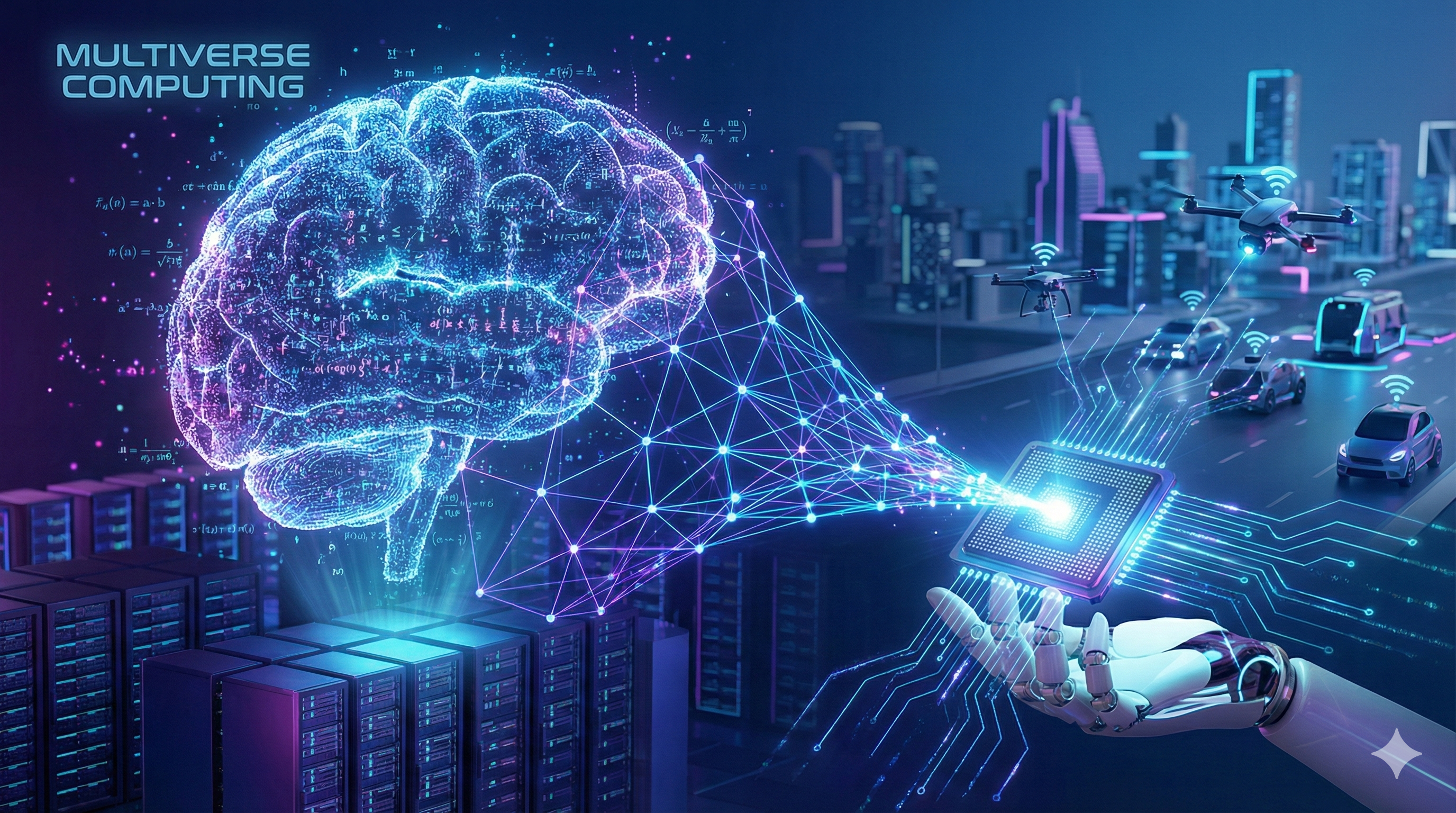
Beyond cloud savings, this technology is a critical enabler for Edge AI. It allows powerful models to run directly on devices with limited resources such as smartphones, autonomous cars, or drones, without relying on a cloud connection, improving latency and privacy.
Business Strategy: Quantum Pragmatism
Since its founding in 2019, Multiverse adopted a philosophy of “Value-Based Quantum Computing.” They moved away from speculation and focused on generating immediate ROI for their clients.
Their strategy is based on several pillars:
- Hardware Agnosticism: Their software platform, Singularity, runs on both current quantum processors (from IBM, D-Wave, etc.) and classical hardware. This mitigates the risk of betting on immature hardware technology.
- Focus on Inference: They have strategically pivoted to address the AI inference market, projected at over $100 billion, where client pain (cost and efficiency) is acute and current.
- Deep Strategic Partnerships: They don’t just sign marketing deals. They have deep technical collaborations that validate their technology in critical environments:
- Finance: With the Bank of Canada, simulating cryptocurrency adoption in complex economic networks intractable for classical computing.
- Energy: With Iberdrola, optimizing battery placement in the power grid to integrate renewables, outperforming classical benchmarks.
- Industry 4.0: With Bosch, integrating quantum algorithms into digital twins for defect detection.
- Consulting: With PwC Spain, which integrates CompactifAI into its service offering, acting as both a client and a distribution channel.
Conclusion: A Bridge to the Quantum Era
Multiverse Computing has achieved what few deep tech startups manage: navigating the “Valley of Death” between academic research and a viable commercial product. They have solved the dilemma of how to monetize quantum science before the hardware is ready.
By applying quantum physics mathematics to solve today’s most urgent AI bottleneck, they have not only built a solid business but have also positioned themselves as a critical piece of infrastructure in the global technology stack. They are a pragmatic bridge between today’s supercomputers and tomorrow’s quantum revolution.
References and Sources
- Multiverse Computing: Official Multiverse Computing website
- Multiverse Computing - Singularity: Singularity Product
- Multiverse Computing - CompactifAI: CompactifAI Product
- Xataka: A startup from San Sebastián “compresses” AI. And the Government has just invested 67 million euros in it
- Multiverse Computing - Funding news: Multiverse Computing Raises $215M to Scale Ground-Breaking Technology that Compresses LLMs by up to 95%.
- Crunchbase: Multiverse Computing Raises $215M At A 5x Valuation Jump To Help Speed Up LLM Rollout
- EurekAlert!: Bank of Canada and Multiverse Computing complete preliminary quantum simulation of cryptocurrency market
- Iberdrola: Iberdrola and Multiverse Computing announce pilot project success to optimise battery installation in the grid