You ask your traditional RAG pipeline an apparently straightforward enterprise question:
“Analyze all 500 contracts and technical audits from the past two years and tell me the three recurring operational bottlenecks shared by our tier-1 suppliers, and which finished products would stall if one of them goes bankrupt.”
Your vector database immediately springs into action. It calculates the cosine similarity of the query embedding against hundreds of thousands of isolated text chunks, retrieves the fifteen most semantically adjacent paragraphs, and feeds them into the model’s context window.
The resulting answer is a predictable disappointment: a superficial, fragmented response that cites two isolated clauses, overlooks the transitive supplier dependencies, and hallucinates the rest.
This failure is not the fault of the underlying foundation model, nor is it a matter of tuning embedding dimensions. It is an architectural limitation intrinsic to flat vector spaces.
After breaking down production pitfalls in RAG: 7 Anti-Patterns and championing pragmatic simplicity in PostgreSQL with pgvector vs Vector DBs, the time has come to explore the most significant technical frontier of 2026: GraphRAG. A breakthrough paradigm that unites Knowledge Graphs with generative intelligence to supply Large Language Models with what vectors alone can never provide: structural comprehension and multi-hop relational reasoning.
The Semantic Blindness of Flat Vector Spaces
To understand why vectors fall short, we must examine how standard vector retrieval operates:
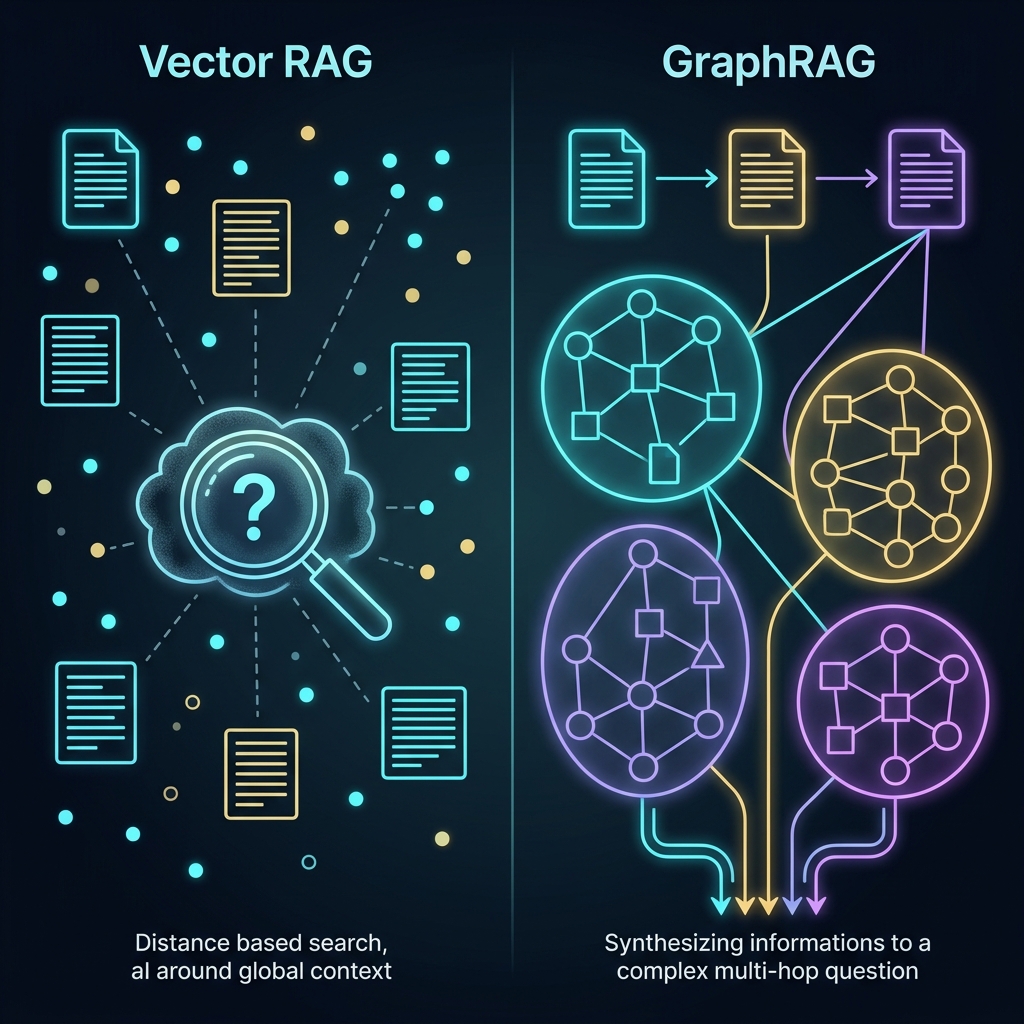
Embeddings map chunks of text into a high-dimensional continuous space. Chunks addressing similar conceptual themes land geometrically close together. This makes vector search remarkably effective at solving needle-in-a-haystack queries:
- “What is our return policy for international deliveries?” ➔ Vector proximity locates with surgical precision the exact section describing that policy.
However, human knowledge and industrial systems rarely exist as disconnected needles in a haystack. They operate as dense, interdependent networks.
Standard vector retrieval suffers from two critical, structural blind spots:
- Inability to Perform Multi-hop Reasoning: If answering a prompt requires traversing a chain from Entity A to Entity B via an intermediate Entity C that shares no immediate vocabulary with the original query, vector search will never bridge the gap. Vectors capture lexical-semantic similarity, but remain blind to causal logic, hierarchical containment, and transitive links.
- Inability to Achieve Global Sensemaking: Queries such as “What are the overarching themes across this legal corpus?” or “What anomalous patterns emerge across customer incident logs?” cannot be answered by pinpointing a single chunk. They require synthesizing the dataset as a cohesive whole.
The GraphRAG Architecture: How Microsoft Broke the Retrieval Barrier
Pioneered by Microsoft Research (Darren Edge, Jonathan Larson, et al.), GraphRAG re-engineers the ingestion and retrieval lifecycle through a four-stage pipeline:
1. LLM-Guided Entity and Relationship Extraction
Rather than blindly slicing text into arbitrary token chunks, an LLM traverses source documents to extract domain entities (people, organizations, components, technologies, regulations) and the explicit relationships binding them, outputting structured semantic triples (Subject, Predicate, Object) alongside rich descriptive summaries.
2. Knowledge Graph Synthesis
The extracted triples are assembled into a unified, clean relational graph, resolving entity co-references and deduplicating aliases across the entire document collection. Nodes represent real-world entities; edges represent documented interactions.
3. Hierarchical Community Detection (The Leiden Algorithm)
Here lies the core innovation of GraphRAG: it applies advanced complex network partitioning — specifically the Leiden community detection algorithm — to segment the graph into hierarchically nested clusters of tightly bound nodes:
- At the top level (macro), it identifies broad thematic domains.
- At intermediate levels, it isolates coherent sub-ecosystems.
- At the granular base (micro), it preserves detailed operational nodes.
4. Precomputed Community Summaries
For each detected community in the hierarchy, an LLM precomputes a comprehensive Community Report summarizing the key entities, operational themes, tensions, and structural takeaways of that cluster.
When a user submits a global exploratory prompt, GraphRAG bypasses millions of unindexed raw tokens: it queries the precomputed hierarchical community summaries in parallel, delivering a structured, macro-level synthesis with dramatically reduced token overhead.
Local Search vs. Global Search
This dual-retrieval mechanism equips AI systems to handle fundamentally different query categories with unmatched precision:
| Query Mode | GraphRAG Mechanics | Ideal Question Types |
|---|---|---|
| Local Search | Traverses the immediate subgraph of an extracted entity, pulling its direct neighbors, typed relations, and raw supporting text snippets. | “What failure history and alternative suppliers are documented for component X?” |
| Global Search | Synthesizes high-level community reports generated across the Leiden partition hierarchy in parallel. | “What are the top strategic operational risks documented across our entire enterprise this quarter?” |
The Stepping Stone to AGI: From Associative Memory to World Models
In our study of Alan Turing, we reflected on how genuine cognition cannot be reduced to the statistical mimicry of adjacent tokens.
Today’s Large Language Models are marvels of associative pattern completion, but they lack an intrinsic, verifiable world model. When a model hallucinates, it does so because it completes probabilistic token sequences unconstrained by a ground truth of hard relational facts.
GraphRAG represents a pivotal leap toward Artificial General Intelligence (AGI) by functioning as the system’s structured hippocampus and associative cortex:
- Neuro-Symbolic Fusion: It unites the flexible language mastery of deep neural networks with the deterministic, auditable rigor of graph theory.
- Elimination of Relational Hallucinations: If the knowledge graph specifies that Component A connects to Subsystem B which relies on Supplier C, an AI agent navigates that path with absolute mathematical fidelity.
- Native Regulatory Auditability: Every synthesized claim can be mapped back to concrete edges, nodes, and source documents, satisfying the rigorous explainability and data governance mandates enforced by the EU AI Act (Article 13).
Industrial Application: From Bill of Materials to Enterprise Operations
At Datalaria, we experience the transformative power of this approach firsthand. In our Obsolescence Radar series, we engineered autonomous systems to audit complex industrial Bills of Materials (BOM).
A bill of materials is not an unstructured document; it is a Directed Acyclic Graph (DAG). Determining whether an obsolete microchip halts the assembly of a satellite or an electric vehicle cannot be resolved by vector similarity; it demands deterministic traversal across hierarchical assembly graphs.
By arming autonomous agents (CrewAI) and Model Context Protocol (MCP) servers with GraphRAG architectures, AI transcends conversational assistants to become a resilient operational diagnostic engine capable of tracing ripple effects across global enterprise operations.
Conclusion
Vector embeddings taught artificial intelligence how to locate isolated data points across the digital expanse. Knowledge graphs teach it how those points interlock to build genuine understanding.
The future of production AI architecture does not require discarding vector search; it calls for orchestrating hybrid systems where vectors provide rapid semantic intuition, while knowledge graphs provide structure, multi-hop reasoning, and immutable truth.
If your ambition is to build AI architectures that do not merely recite text, but genuinely reason across your organization’s complex reality, the path forward is clear: stop treating enterprise data as a cloud of blind points and start treating it as the living graph it truly is.
Sources of Interest:
- Microsoft Research: Project GraphRAG — Unlocking LLM Discovery on Complex Data
- arXiv (2024): From Local to Global — A Graph RAG Approach to Query-Focused Summarization
- YouTube: GraphRAG Methods for Optimized LLM Context Windows (Jonathan Larson)
- GitHub: Microsoft GraphRAG Official Repository
- Datalaria: RAG in Production — 7 Anti-Patterns That Destroy Precision
- Datalaria: PostgreSQL with pgvector vs Dedicated Vector DBs
- Datalaria: Alan Turing — The Genius Who Asked if Machines Could Think
- Datalaria: Obsolescence Radar with BOM Component Graphs
- Datalaria: MCP Protocol — The Connection Standard for AI
- Datalaria: EU AI Act — Practical Guide to Governance and Explainability