In 1814, French mathematician and astronomer Pierre-Simon Laplace formulated one of the most famous thought experiments in scientific history: if a hypothetical supreme intellect — known to history as Laplace’s Demon — knew the exact position and momentum of every atom in the universe at any given moment, nothing would be uncertain. The past and the future would lie unfolded before its eyes with the same mathematical certainty as the present. Free will would be nothing more than an illusion born of human ignorance of underlying variables.
Two centuries later, acclaimed filmmaker and novelist Alex Garland (Ex Machina, Annihilation) loaded that philosophical postulate into a million-qubit quantum processor in the gripping miniseries “DEVS” (FX / Hulu).
Just as we explored in The Thinking Game with DeepMind’s quest toward AGI, or in Halt and Catch Fire with the foundational era of personal computing, this post breaks down the physical, computational, and ethical pillars of DEVS: the piece of media that has most surgically understood the chilling intersection between quantum mechanics, strict determinism, and Silicon Valley hubris.
The Premise: The Golden Cube in the Redwood Forest
The narrative unfolds in the Santa Cruz Mountains south of Silicon Valley, on the secluded campus of Amaya, an omnipotent tech titan led by the enigmatic CEO Forest (played with mesmerizing gravitas by Nick Offerman). In the middle of an ancient redwood forest, beneath the shadow of a colossal golden statue of a little girl (Amaya, Forest’s deceased daughter), lies a secret facility built of brutalist concrete.
At the core of this complex floats a monolithic cube of pure gold, suspended in an absolute electromagnetic vacuum via magnetic levitation. This design is no mere stylistic flourish; it addresses the greatest practical hurdle in real-world quantum hardware: quantum decoherence.
For quantum bits (qubits) to maintain their fragile states of superposition (existing in linear combinations of 0 and 1 simultaneously) and entanglement, they must be completely shielded from environmental thermal, acoustic, gravitational, or electromagnetic interference. If a single stray photon or microscopic vibration interacts with the system, the quantum wave function collapses, corrupting the calculation instantly.
Inside this golden Faraday cage, an elite team of physicists and cryptographers — including Sergei, Lyndon, Stewart, and Katie (Alison Pill) — works on software whose true purpose is shrouded in quasi-religious secrecy: building a quantum engine capable of reconstructing the past and projecting the future with subatomic fidelity.
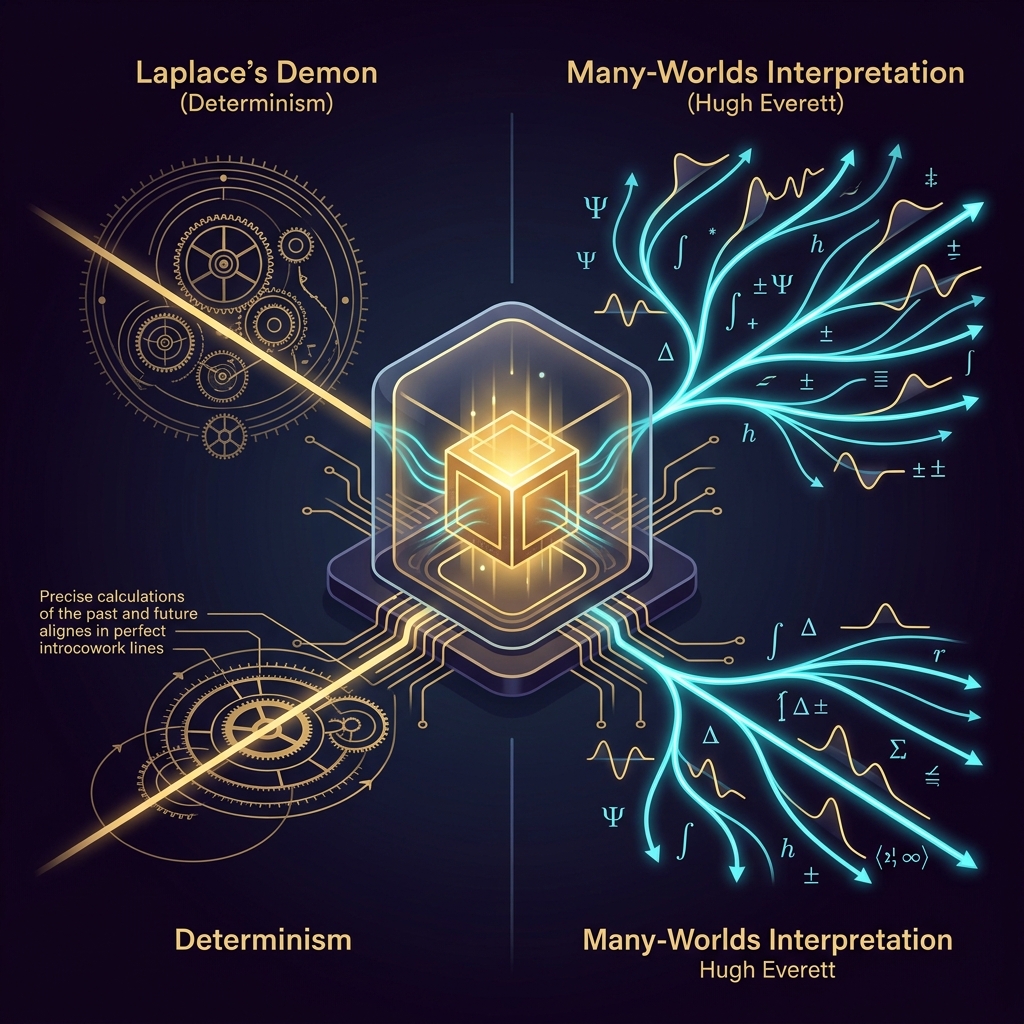
The Clash of Paradigms: Determinism vs. Everett’s Multiverse
The central dramatic and intellectual conflict of DEVS erupts between two irreconcilable interpretations of quantum physics:
1. Pilot Wave Theory (De Broglie–Bohm) and Strict Determinism
Forest fiercely defends a deterministic cosmos. He adheres to a quantum version of De Broglie–Bohm hidden-variable theory: the universe is a single, unbending timeline governed by unbreakable cause-and-effect mechanics. If the quantum computer ingests sufficient boundary parameters, it can render the past with absolute certainty: Socrates drinking hemlock, Christ on the cross, or his own daughter blowing bubbles in their living room moments before the fatal car crash that took her life.
For Forest, determinism is an essential psychological sanctuary: if the universe is a tram on fixed rails where every second was determined since the Big Bang, he bears no moral guilt for the tragedy that killed his family.
2. Hugh Everett III’s Many-Worlds Interpretation
However, Amaya’s early projections suffer from a fatal flaw: images of the past appear blurred, obscured by a deafening static of white noise that renders faces and voices unreadable.
Young programming prodigy Lyndon discovers the mathematical breakthrough: the noise arises because the algorithm attempts to force reality into a single, singular timeline. When Lyndon refactors the codebase using Hugh Everett’s Many-Worlds Interpretation (postulating that every quantum measurement branches the universe into infinite parallel realities in superposition), the screen immediately resolves into breathtaking, pristine 4K video and crystal-clear audio.
Forest’s reaction to this triumph is telling: instead of rewarding Lyndon, he fires him on the spot. Why? Because if the simulation is powered by Everett’s multiverse, the little girl laughing on the screen is not his daughter Amaya in his timeline, but an alternate variant across a parallel dimensional branch. For Forest, an infinite multiverse robs his grief and mission of all purpose.
The Simulation Paradox and the Collapse of Free Will
As the system’s quantum compute scales exponentially, the engine ceases looking merely backward and begins computing the immediate future.
Here, the series dives headlong into the most chilling recursive paradox in science fiction:
- If the quantum computer renders on a screen in front of you with absolute accuracy what you will do five seconds from now… do you possess the free will to disobey the screen?
- If you decide to cross your arms because the screen showed you clapping, the machine’s predictive calculations already factored in your desire to rebel, showing you crossing your arms in the first place.
The characters become trapped in a waking nightmare: they turn into living automatons, reciting aloud the dialogue the monitor displayed seconds prior. Absolute prediction obliterates agency.
This Gordian knot is broken only by Lily Chan (Sonoya Mizuno). In the climactic confrontation, faced with the machine’s unbending prediction that she will shoot Forest in the quantum elevator, Lily makes an unprecedented choice: she throws the handgun out of the door just before it seals. In that infinitesimal moment, human free will shatters algorithmic determinism. The quantum engine, blind beyond that point of infinite bifurcation, suffers a catastrophic breakdown in its event horizon.
The True Meaning of DEVS: Technology as Modern Theology
Near the conclusion of the series, Alex Garland reveals the linguistic key underpinning the title: in classical Roman Latin, the character ‘V’ was used interchangeably for the letter and sound ‘U’. The secretive project was never named DEVS; it was always DEUS (the Latin word for God).
Garland offers no naive technological utopianism. DEVS stands as an eerie parable about the unchecked power of contemporary tech monopolies: corporations commanding capital reserves exceeding the GDP of sovereign nations, operating beyond democratic oversight, assuming the role of digital demiurges deciding what is real.
Connections to Real Quantum Computing and AI in 2026
While DEVS is speculative philosophical fiction, its themes directly mirror the frontiers of modern computer science:
- Real Quantum Hardware: Pioneer institutions like IBM Quantum, Google Quantum AI, and European deep-tech leaders like Spain’s Multiverse Computing are leveraging quantum tensor networks to tackle intractable combinatorial optimization and perform radical model compression on modern LLMs.
- Information and Entropy: Amaya’s obsessive need to eliminate thermal noise is the physical manifestation of Claude Shannon’s Information Theory: isolating the signal from the noise is the fundamental precondition for computation.
- Probability vs. Certainty: While Forest seeks absolute Newtonian certainty, modern data engineering and machine learning operate squarely within the paradigm of Thomas Bayes: we cannot know the universe with absolute determinism; we can only continuously update our probabilistic posteriors as new data arrives.
- Ethical AI and Algorithmic Governance: The opaque, predictive surveillance machinery of Amaya represents the exact category of risk that the EU AI Act regulates under its High-Risk and Prohibited classifications: predictive systems that manipulate human behavior without human-in-the-loop oversight.
Conclusion
DEVS is a masterpiece of speculative television because it is not about lasers or robot uprisings; it is about the human search for meaning against the vastness of the cosmos.
It reminds us that the urge to forecast the future or resurrect the past does not originate in mathematics; it is born of love, grief, and regret. And it leaves us with an enduring insight: no matter how many qubits your hardware harnesses or how many parameters your neural network optimizes, uncertainty is not a flaw in the universe; uncertainty is the very sanctuary where human freedom lives.
Sources of Interest:
- Hulu / FX: DEVS — Official Series Hub
- YouTube: DEVS (Hulu) — Official HD Series Trailer
- Stanford Encyclopedia of Philosophy: The Many-Worlds Interpretation of Quantum Mechanics
- Datalaria: Multiverse Computing — Spanish Quantum Tensor Software
- Datalaria: The Thinking Game — Demis Hassabis and DeepMind
- Datalaria: Halt and Catch Fire — The History of Software
- Datalaria: Claude Shannon — Information Theory and Entropy
- Datalaria: Thomas Bayes — Probabilistic Inference
- Datalaria: EU AI Act — Engineering Guide to Algorithmic Ethics